Resources · Crew induction
Crew Induction Requirements Under Marine Order 504 (MO 504)
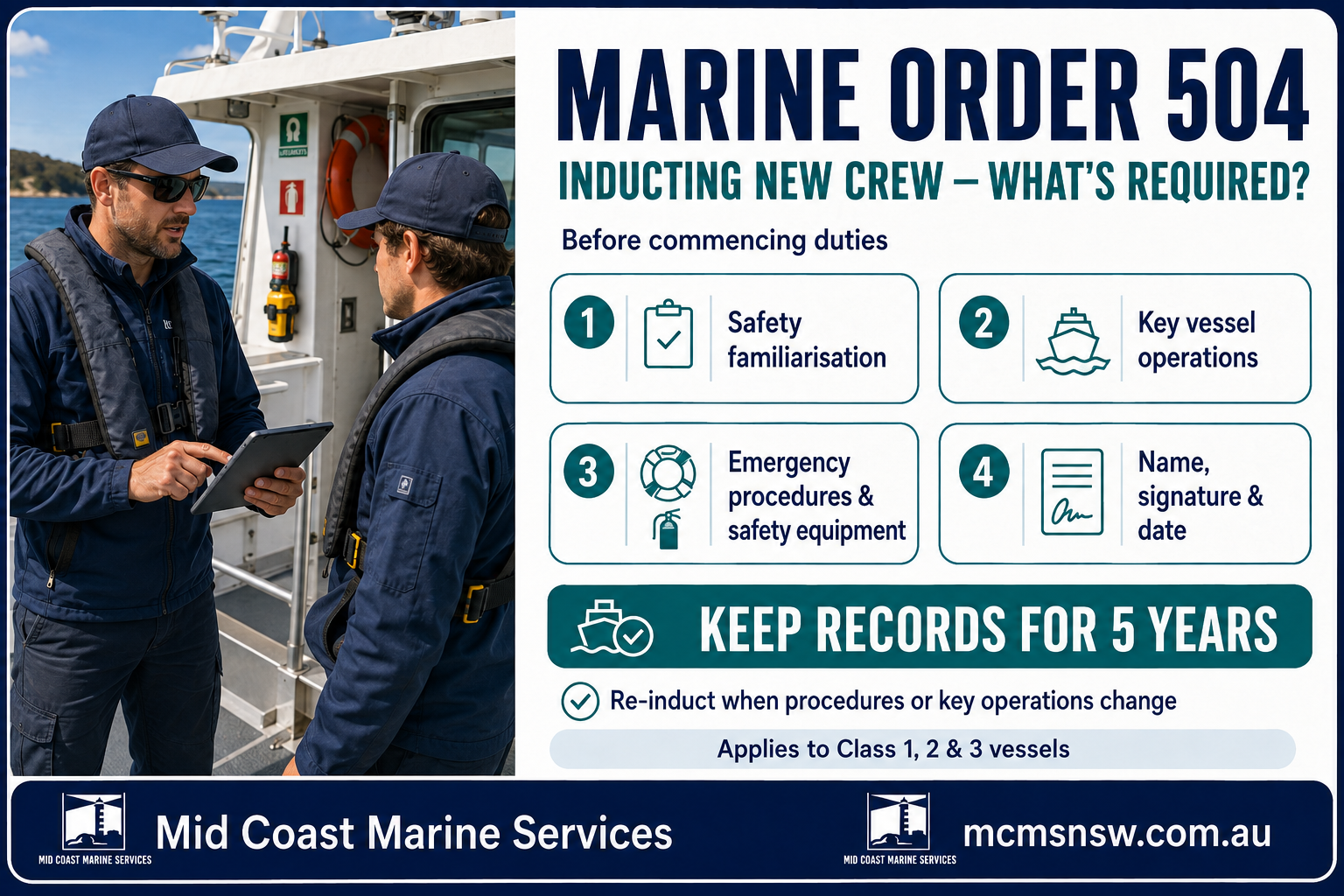
Who it covers. Every master and crew member, before they start duties and as soon as practicable after they join the vessel. It also covers shore-based people involved in running the vessel — someone helping with lines and berthing, for instance. The only exemption is Class 4 vessels, which clause 9 doesn't apply to at all.
The three parts. An induction isn't one conversation; the Order breaks it into three distinct things, and all three have to happen.
Safety training — familiarising the person with the safety matters that come with simply being on board, and with the particular job they'll be doing. A deckhand and a cook face different hazards.
Induction into key vessel operations — enough that they can carry out their assigned duties safely. Note the wording: you must establish, maintain and verify their competence. Telling them isn't enough. You need to satisfy yourself they can actually do it.
Emergency procedures training — the procedures in your emergency plan for the situations it lists, plus how to use the life-saving equipment on board. Again the test is whether they can respond rapidly and effectively, not whether they've been shown.
Who delivers it. The master, or a crew member the master considers has the right skills and knowledge.
Drills. Separate from induction, and ongoing. Emergency drills run at a frequency set by your vessel's risk assessment, to test the procedures and confirm people can actually respond.
Passengers. A different, lighter requirement: a safety induction covering relevant operational and emergency procedures, including lifejackets, given as soon as practicable after they board. Group inductions are allowed, and the timing and format are up to you depending on how the vessel operates.
Records — five years. This is where operators most often come unstuck. For every induction and every drill you must keep a description of what was covered, the name and signature of each person who took part, and the date. Signatures, not just a list.
When things change. If you alter key vessel operations or emergency procedures, induct and re-familiarise the crew against the updated safety management system. An induction done against superseded procedures no longer counts.
None of clause 9 applies to Class 4 vessels.
Source: Marine Order 504 (Certificates of operation — national law) 2024 — Schedule 1, clauses 9 and 11(5)(f).
The same applies to shore-based people involved in running the vessel — someone helping with berthing, for example.
The master gives the training, or a crew member the master judges has the right skills.
Emergency drills run at a frequency your risk assessment sets, to prove the crew can respond.
Passengers get their own safety induction — operational and emergency procedures, including lifejackets — as soon as practicable after boarding. Group inductions are fine.
Keep records for five years: what was covered, the drills, the names and signatures of everyone who took part, and the date.
Redo the induction whenever key operations or emergency procedures change.
None of clause 9 applies to Class 4 vessels.