Resources · Risk assessment
How to Conduct a Risk Assessment for a Commercial Vessel
A risk assessment is the engine room of your safety management system. Here's AMSA's four-step process, in plain English, with a worked example you can adapt to your own operation.
By Mid Coast Marine Services
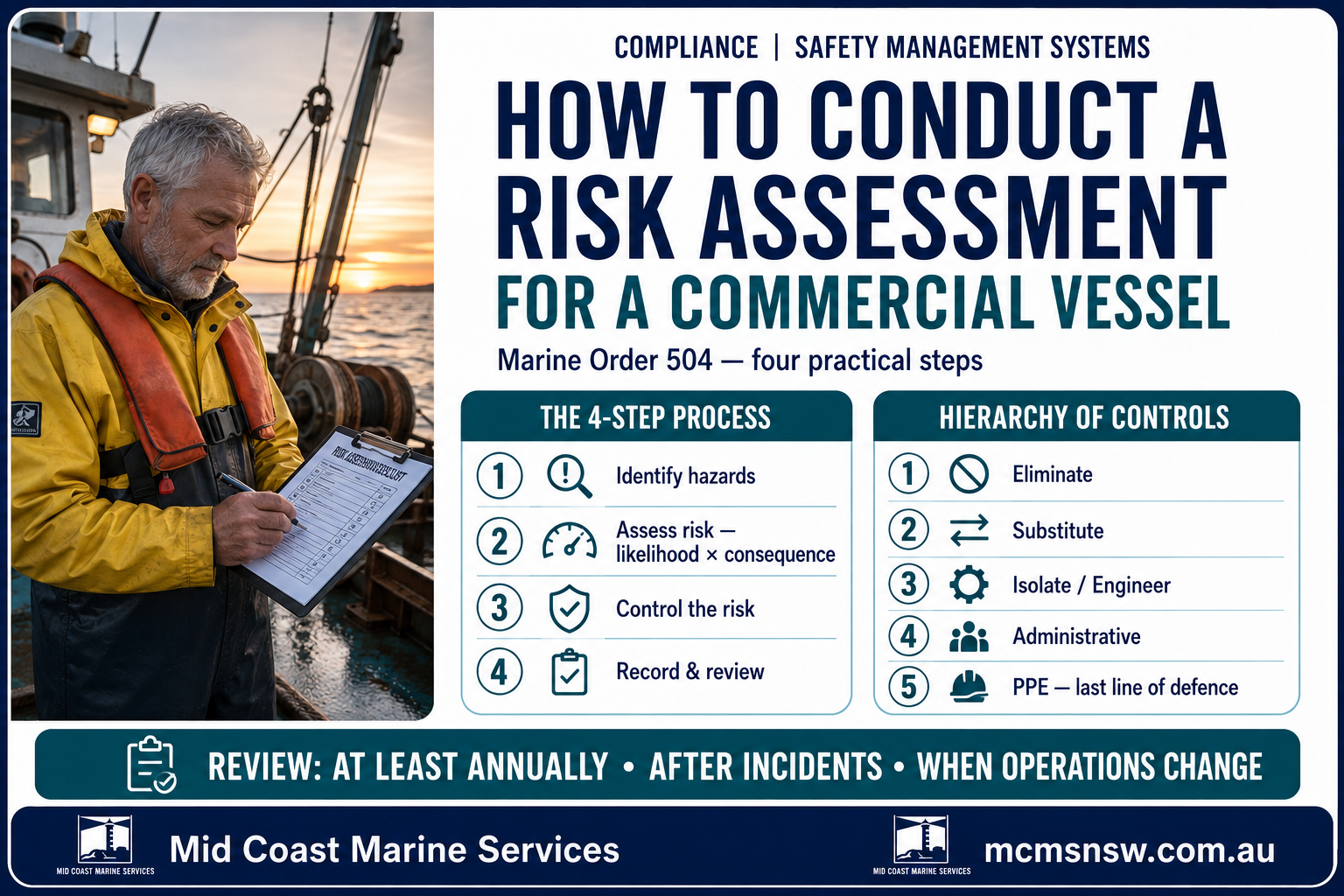
A safety management system (SMS) is only as good as the thinking behind it — and that thinking is your risk assessment. It's the process of working out what could go wrong on your vessel, how serious it would be, and what you'll do to prevent it. Under Marine Order 504, every domestic commercial vessel (DCV) must have a documented risk assessment as part of its SMS, and it must be reviewed at least annually and after any incident.
The good news: AMSA breaks it into a simple, repeatable four-step process. You don't need to be a safety consultant to do it well — you need to know your operation, and to be honest about its hazards.
The four steps at a glance
1. Identify the hazards → 2. Assess the risk → 3. Control the risk → 4. Record and review.
Step 1 — Identify the hazards
A hazard is anything with the potential to cause harm. Walk through your operation from start to finish — leaving the berth, transit, the actual work, and returning — and list everything that could hurt someone or damage the vessel. Every operation is different, and some hazards will be unique to yours.
Typical hazard sources include:
- Weather and sea conditions — wind, swell, poor visibility, night operations.
- Machinery and equipment — engines, winches, net reels, deck gear, knives and hooks.
- The work itself — hauling heavy pots, manual handling, working near the side, slips on a wet deck.
- The vessel — stability, overloading, fire, flooding, loss of propulsion.
- People — fatigue, inexperience, passengers moving about, man overboard.
A great way to surface hazards is to talk to your crew and other operators — the people doing the job usually know where the dangers hide.
Step 2 — Assess the risk
For each hazard, weigh up two things: how likely it is to happen, and how severe the outcome would be. AMSA describes these as likelihood and consequence.
- Likelihood ranges from Rare (very unlikely) through to Almost certain (expected to happen regularly).
- Consequence ranges from Insignificant (no injury, negligible cost) through to Catastrophic (fatalities or major environmental damage).
Combining the two on a risk matrix gives each hazard an overall rating — from Low to Extreme. This isn't about false precision; it's about prioritising. The higher the rating, the more urgent and robust your controls need to be.
Step 3 — Control the risk
Now decide how you'll reduce each risk to an acceptable level. AMSA expects you to work down the hierarchy of controls — always reaching for the most effective option you reasonably can, and treating personal protective equipment as the last line of defence rather than the first.
| Most effective → | Control | Example on a vessel |
|---|---|---|
| 1 | Eliminate | Remove the hazard entirely — e.g. stop an unsafe practice, or don't carry a load that compromises stability. |
| 2 | Substitute | Replace with something safer — e.g. a lighter pot, a safer chemical, mechanical hauling instead of manual. |
| 3 | Isolate / engineer | Guard machinery, add non-slip decking, fit rails or barriers, improve deck layout. |
| 4 | Administrative | Procedures, training, checklists, work-rest scheduling, signage. |
| Least effective | PPE | Lifejackets, gloves, eye protection — the last line of defence, not the first. |
Most real-world controls combine several levels. And note: AMSA specifically requires you to consider lifejacket wear whenever you develop or review your risk assessment.
Step 4 — Record and review
Capture it all in a simple working document that lists your operations, the hazards, the risks, and the controls you've put in place. It doesn't need to be elaborate — a clear table your crew can actually read beats a thick binder no one opens.
Then keep it alive:
- Review at least annually (a Marine Order 504 requirement).
- Review after any incident or near-miss — these tell you where a control failed or was missing.
- Review when something changes — new gear, new crew, a new type of work or area of operation.
A worked example
Say you run a small fishing vessel hauling pots at night. One hazard is working near the side in the dark; the associated risk is a person going overboard and drowning. Likelihood might be Possible and consequence Catastrophic — a high overall rating that demands strong controls.
Working down the hierarchy, you might: improve deck lighting and fit rails (engineering); set a rule that hauling only happens with two people and no one works alone at the side after dark (administrative); and require lifejackets to be worn on deck at night (PPE). Together, those controls bring the risk down to an acceptable level — and you record exactly that in your risk assessment.
Simplified risk assessments for small operators
If you run a small vessel — broadly, under 7.5m with one or two crew and no passengers — AMSA offers a simplified risk assessment approach. The four steps are the same, but the paperwork is lighter and the emphasis is on practical, real-world thinking: talk it through with your crew and other operators, focus on the hazards that genuinely apply to your work, and keep a concise written record. This pairs neatly with a simplified SMS if your vessel is eligible for one.
Common mistakes to avoid
- Generic, copied assessments that don't reflect your actual vessel and operation.
- Jumping straight to PPE instead of first asking whether the hazard can be eliminated or engineered out.
- “Set and forget” — an assessment that's never reviewed quickly goes stale.
- Leaving crew out — the people doing the work spot hazards you'll miss from the office.
How MCMS can help
At Mid Coast Marine Services we help operators along the NSW coast build risk assessments that are genuinely useful — thorough enough to satisfy AMSA and Marine Order 504, but practical enough that your crew will actually use them. Whether you need a full assessment for a crewed vessel or a simplified one for a small owner-operated boat, we can work through it with you.
Get in touch: info@mcmsnsw.com.au
This article is general information current as at August 2026 and is not a substitute for AMSA's official requirements. Always confirm your obligations against AMSA's current guidance and Marine Order 504, or speak with MCMS. Source: Australian Maritime Safety Authority (amsa.gov.au).