COMPLIANCE | DOMESTIC COMMERCIAL VESSELS
AMSA's Simplified Safety Management System: Do You Qualify — and What Does It Actually Involve?
Since 1 June 2025, AMSA's amended Marine Order 504 has made a lighter-touch “simplified SMS” available to smaller, lower-risk operators. Here's who's eligible, who isn't, and what a simplified system needs to contain.
By Mid Coast Marine Services
If you run a small commercial boat — a fishing vessel, a hire-and-drive tinny, or a modest non-passenger workboat — you've probably felt that a full safety management system (SMS) can be heavy going for a one- or two-person operation. AMSA has heard the same. As part of the changes to Marine Order 504 that took effect on 1 June 2025, there is now a simplified SMS pathway designed specifically for smaller, less complex domestic commercial vessels (DCVs).
It's not a loophole and it's not “no paperwork.” You still need a documented, working SMS. But the simplified version strips out a lot of the content that doesn't make sense for a small owner-operated boat, so the system is quicker to build and easier to keep current. Below is a plain-English rundown.
First, what actually changed?
Every DCV in Australia must operate under an SMS. The 2025 amendments to Marine Order 504 refreshed what an SMS has to cover, and introduced a two-tier approach: a standard SMS for most vessels, and a new simplified SMS for eligible small operators. If your vessel qualifies, you can choose to run the simplified version instead of the full one.
Who qualifies for a simplified SMS?
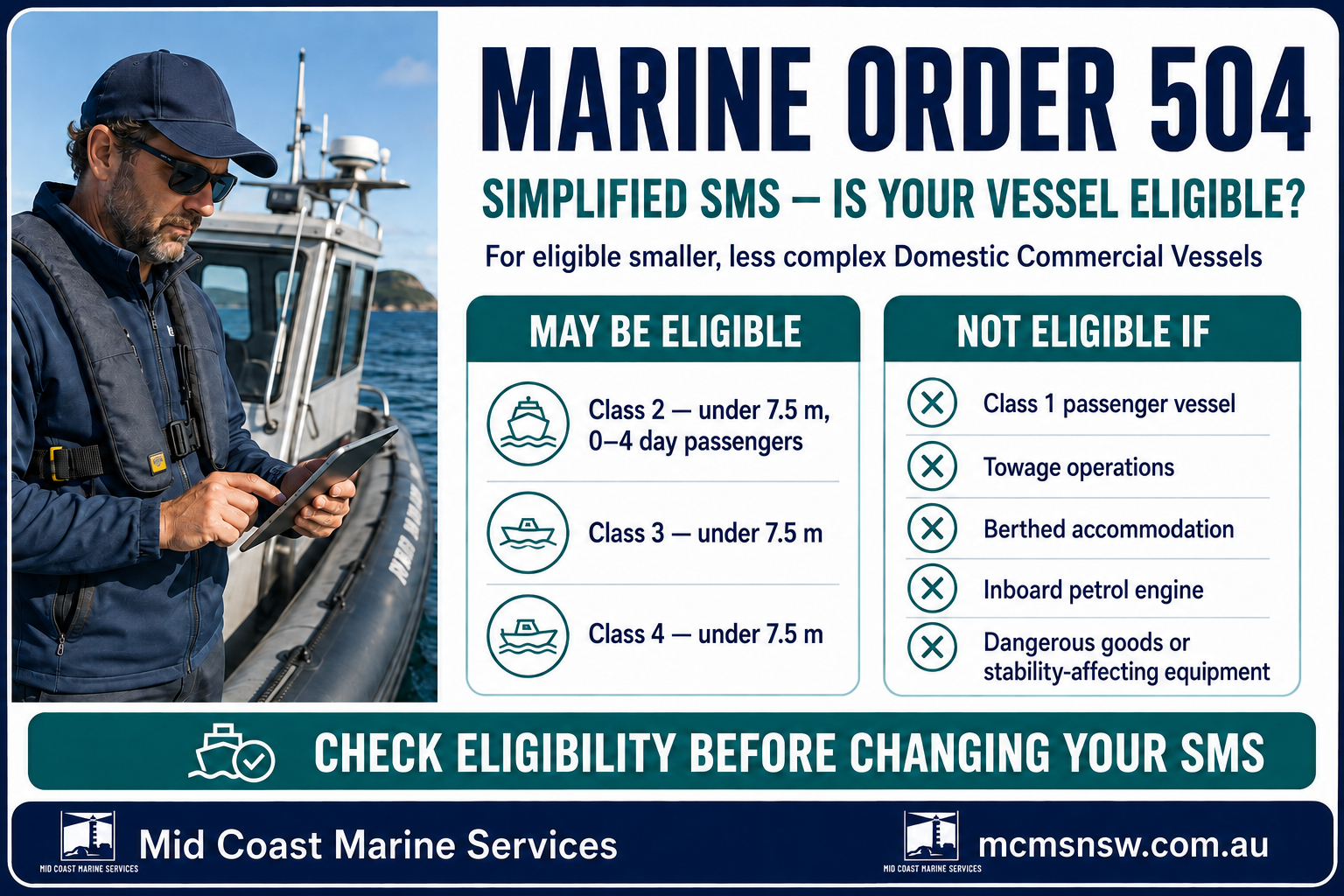
To be eligible, your vessel must be less than 7.5 metres in length, AND fall into one of the following classes:
- Class 2 (non-passenger vessels) carrying no more than 4 day passengers
- Class 3 (fishing vessels)
- Class 4 (hire-and-drive vessels)
If your boat is 7.5 metres or longer, or it's a passenger (Class 1) vessel, the simplified pathway isn't open to you — you'll run a standard SMS.
Who is excluded — even if under 7.5m?
Meeting the size and class test isn't the whole story. Your vessel is not eligible for a simplified SMS if it does any of the following:
- Carries dangerous goods.
- Has a net reel, crane, lifting device or deck load whose use is likely to adversely affect the vessel's stability or watertight integrity.
- Uses an inboard engine running on fuel with a flashpoint below 60°C (for example, petrol).
- Has berthed (sleeping) accommodation.
- Is set up for towage operations.
- Is otherwise deemed unsuitable by AMSA for a simplified SMS.
If any of these apply, you'll need a standard SMS — even if the boat is small.
What does a simplified SMS involve?
A simplified SMS is still a genuine, documented safety management system. What changes is the amount of content required. Because it's built around an owner-operator model, several requirements that exist to manage larger crews and more complex operations are reduced or removed. In practice:
- No separate designated person statement is needed if the owner is also the designated person.
- No separate master's statement is needed if the owner is also the master — though the master's authority and responsibilities are still made clear.
- Risk assessments don't need to itemise routine daily crew tasks — the focus is on the real hazards of the operation.
- Fewer mandatory operational procedures than a full SMS.
- Assembly stations aren't mandatory in the emergency plan; alternatives are acceptable where practicable given the vessel's layout, characteristics and risk assessment.
- Reduced crew-list detail.
What you still must address:
- A drug and alcohol policy to manage those risks.
- Fatigue management within your risk assessment (this applies to Class 2 and Class 3; it is not required for Class 4 hire-and-drive).
- Cargo and dangerous-goods handling procedures where relevant to your operation.
- Emergency plans covering scenarios such as loss of propulsion and fuel or oil spills, where applicable.
- A clear statement of the master's authority and responsibilities.
How to move to a simplified SMS — the practical steps
- Confirm eligibility. Check your vessel against the size, class and exclusion tests above.
- Learn what's required. Review AMSA's simplified-SMS guidance and templates so you know what content your system needs.
- Build or convert your SMS. Populate the simplified template with your vessel's real hazards, procedures and emergency arrangements — not generic filler.
- Implement it on the water. An SMS only works if it reflects how you actually operate and everyone on board knows it.
- Keep it current. Review after any incident, change of operation, or new equipment.
One important catch: eligibility can change
Eligibility is self-assessed and ongoing. If your operation changes so that you no longer meet the criteria — you start carrying dangerous goods, fit a crane that affects stability, or take on towage work, for example — you must move up to a standard SMS. It's worth reassessing whenever your work or your vessel changes.
How MCMS can help
At Mid Coast Marine Services we work with owner-operators, fishers and hire-and-drive operators up and down the NSW coast to get their safety management systems right the first time. If you're not sure whether your vessel qualifies for a simplified SMS — or you'd like a compliant system built around how you actually operate rather than a generic template — we can take it off your plate.
Get in touch: info@mcmsnsw.com.au
This article is general information current as at August 2026 and is not a substitute for AMSA's official requirements. Always confirm your obligations against AMSA's current guidance for Marine Order 504 and the simplified SMS, or speak with MCMS. Source: Australian Maritime Safety Authority (amsa.gov.au).