
MID COAST MARINE SERVICES | RESOURCES
Commercial Vessel Maintenance Records: What to Keep Under MO 504
Oct 5, 2026
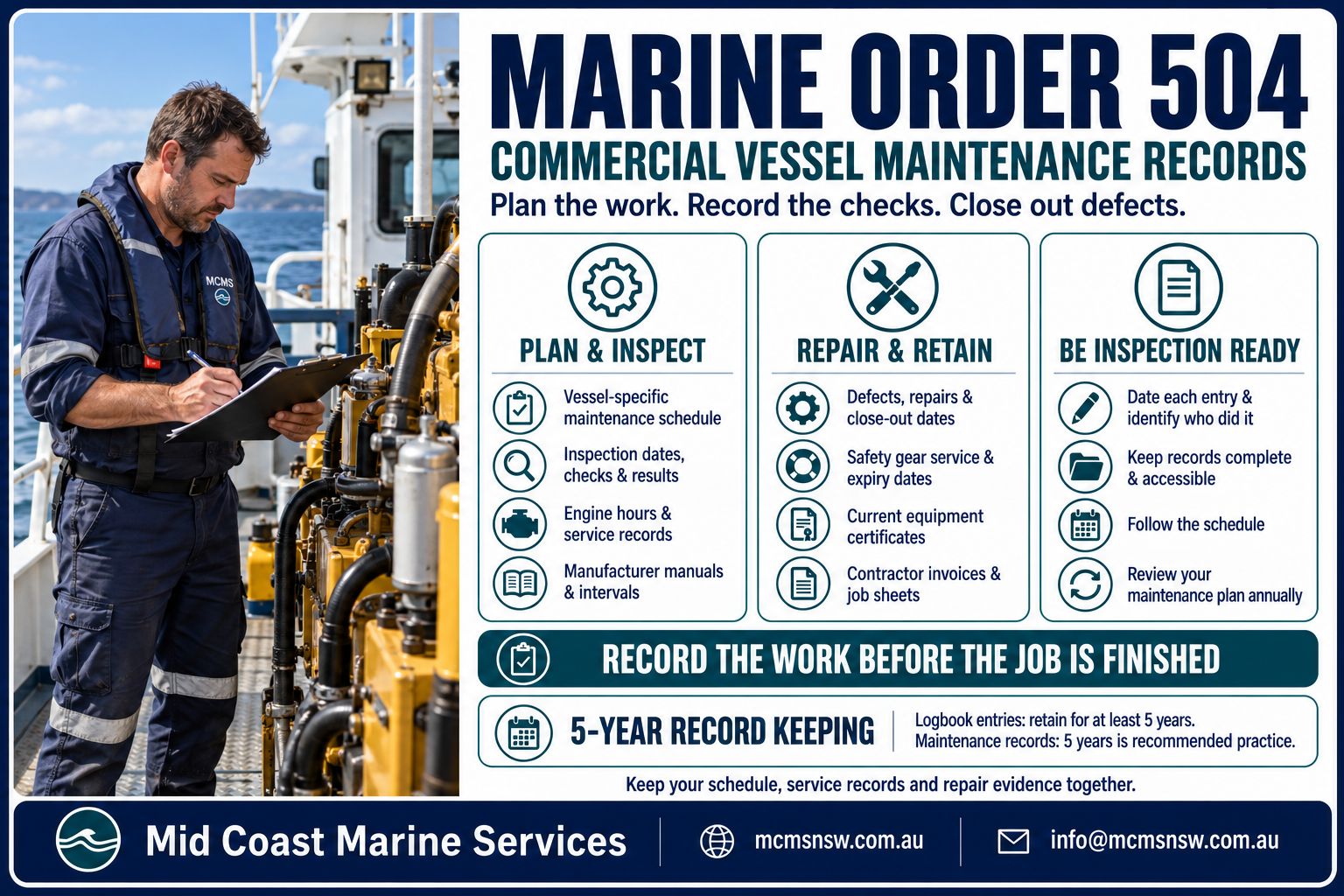
If you run a domestic commercial vessel, your maintenance records are your proof that the boat is safe. Marine Order 504 says you must have a planned maintenance system and must record what you check and fix. If it isn't written down, a marine inspector will treat it as not done.
This guide sets out, in plain English, what the rules say, which records to keep, how long to keep them, and the mistakes we see most often.
What MO 504 actually requires
The revised Marine Order 504 started on 1 June 2025. Clause 14 of Schedule 1 covers maintenance. In plain English, your safety management system (SMS) must:
- Have a planned maintenance system. Regular, scheduled inspection and maintenance that suits your vessel, its machinery and its equipment. You must build it, keep it up to date, and actually use it.
- Record each inspection. Write down the details of every inspection you do.
- Fix and record defects. Have a way to correct anything an inspection finds, and record that it was fixed.
- Inspect enough to know the boat is compliant. The owner, or someone with enough experience and knowledge, does the checks.
- Follow the manufacturer. Service the vessel taking into account the manufacturer's specifications and requirements.
AMSA says the maintenance record can be kept in the logbook. A spreadsheet, paper forms or a computerised maintenance system also work, as long as the records are complete and easy to find.
What records to keep
Use this as a checklist. If you can produce each of these on request, you're in good shape.
| Record | What it should show |
|---|---|
| Planned maintenance schedule | Each item, how often it's checked or serviced, and who is responsible |
| Inspection records | Date, what was checked, who checked it, and the result |
| Defect and repair records | What was found, when, what was done to fix it, and when it was closed out |
| Engine and machinery service records | Hours, oil and filter changes, impellers, belts and parts replaced, done to the manufacturer's schedule |
| Safety equipment servicing | Liferaft, EPIRB, fire extinguishers, flares, lifejackets, with service and expiry dates |
| Certificates of currency | Current service certificates for equipment you're required to carry (Marine Order 503) |
| Breakdown and unplanned work | What failed, the cause if known, and the fix |
| Manuals and manufacturer specs | Equipment manuals kept on board or easy to access |
| Contractor work | Invoices and job sheets from shipwrights, engineers and service agents |
| Logbook entries | Any maintenance, defect, incident or unusual occurrence recorded in the logbook |
Every entry should be dated, legible and signed or initialled. Records must not be false or misleading.
How long to keep them
Keep maintenance records for at least 5 years. MO 504 requires logbook entries to be kept for at least 5 years after they are made, on board or ashore. Training records also have a 5-year rule. MO 504 doesn't set a separate period for maintenance records, but since they can sit in the logbook, 5 years is the safe standard.
The records must be readily accessible. If an inspector asks, you need to produce them without delay.
What an inspector will look for
- A maintenance schedule that matches your actual vessel and equipment, not a generic template
- Evidence the schedule is being followed, with dates that line up
- Defects that were recorded and then closed out
- Safety gear that is in date and serviced
- Servicing that matches the manufacturer's intervals
- An SMS that has been reviewed in the last 12 months, as MO 504 requires each procedure to be reviewed every 12 months
Common mistakes and how to avoid them
- Doing the work but not writing it down. Make recording part of the job, so it's done before the job is called finished.
- A plan that doesn't match the boat. A template listing equipment you don't carry tells an inspector the SMS was never tailored to your vessel. Build it around your actual gear.
- Defects left open. A defect recorded with no repair date looks worse than no record at all. Close every one out, or note why it's safe to keep operating.
- Records spread everywhere. Invoices in the ute, notes on a phone, a logbook on board. Keep one system and file everything into it.
- Expired safety gear. Put every expiry and service date into the schedule so nothing is missed.
- No annual review. Set a fixed date each year to review the SMS and the maintenance plan, and record that you did it.
A simple tip: check the schedule at the start of each week, and file paperwork the same day the work is done.
Need help getting your records in order?
Mid Coast Marine Services helps domestic commercial vessel operators set up a planned maintenance system and SMS that fits their vessel and stands up to inspection. Contact us at info@mcmsnsw.com.au to talk through your vessel.
This article is general information only. Always check the current Marine Order 504 and AMSA guidance for your vessel's class and operation.
Sources
- Marine Order 504 (Certificates of operation – national law) 2024
- AMSA – Planned maintenance on domestic commercial vessels
- AMSA – Guidelines for a safety management system
- AMSA – Changes to SMS requirements from 1 June 2025
This article is a general guide only. Check your obligations against the current Marine Order 504 and AMSA guidance for your vessel.