Crewing (Manning) Risk Assessment Under Marine Order 504: A Plain-English Guide
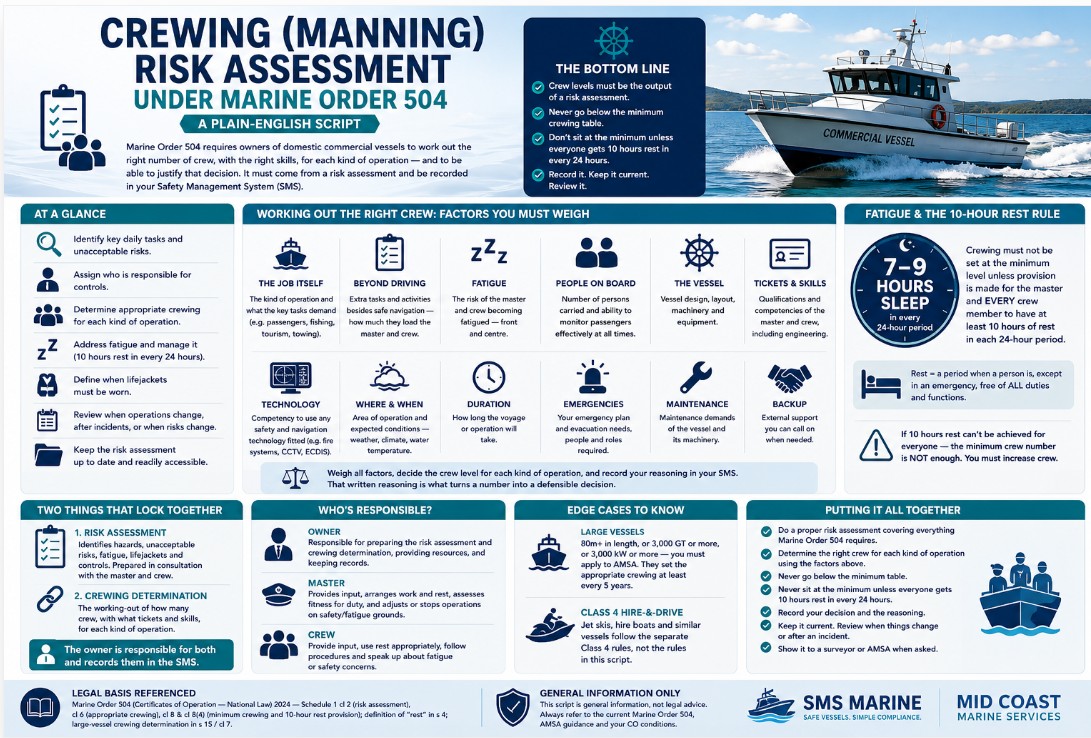
If you run a domestic commercial vessel in Australia, Marine Order 504 (MO 504, also written MO504) asks you to answer a simple-sounding question: how many people do you need on board, with what skills, to run this vessel safely? That's your crewing — some people still call it "manning" — and under MO 504 you can't just pick a number out of habit. You have to work it out properly, write down how you got there, and be able to show a surveyor or an AMSA inspector your reasoning. In plain terms, your crewing decision has to come out of a risk assessment. Here's the method.
Two things that lock together
Two parts of your safety management system (SMS) deal with this, and they're joined at the hip.
The first is your risk assessment — the document (a risk register is a good format) where you identify the hazards of running your vessel and how you control them. MO 504 says that risk assessment must specifically cover your crewing and must specifically cover fatigue.
The second is your appropriate crewing determination — the actual working-out of how many crew, and with what tickets and skills, each kind of operation needs.
So the risk assessment tells you what could go wrong and who's exposed; the crewing determination is the staffing answer you build from it. You record both in your SMS. And one point up front: the owner is responsible for all of this. You prepare it in consultation with the master and crew — the people actually doing the job — but the legal duty sits with the owner.
What your risk assessment must identify
Marine Order 504 spells out what the risk assessment has to identify. In plain English:
- Your key daily tasks — the real jobs the master and every crew member do on a normal day.
- The unacceptable risks — the things that could seriously harm the vessel, upset its stability, damage the operating environment, or hurt people on or near the vessel. Think collision or grounding, fire, someone going overboard and drowning, or dangerous gases.
- Who's responsible for making sure the actions to remove or reduce each risk actually get done. Every control needs an owner — a name, not just a good intention.
- Your crewing — the appropriate crewing and any crewing determination.
- Fatigue — the risk of the master and crew becoming fatigued, and how you're going to manage it. This is now a named, mandatory item. Your state or territory work health and safety laws sit on top of this and still apply.
- Lifejackets — when a lifejacket must be worn by anyone on board.
This isn't a "write it once and file it" document. Keep it readily accessible and up to date, and review it whenever you do an operation different from your normal one, whenever the vessel is involved in a marine incident, or whenever the master considers the risks have changed. If AMSA or an inspector asks to see it, you hand it over.
Working out the right crew — the factors you must weigh
The rule is that the owner must determine the appropriate crewing for each kind of operation — so if you run charters some days and fishing or towing on others, each may need its own answer. You work it out by looking at the risks to the vessel, to the environment, and to anyone on or near the vessel. Marine Order 504 then gives you a checklist you must take into account:
- The job itself — the kind of operation and what the key tasks demand (carrying passengers, fishing and tourism all load the crew differently).
- Everything beyond just driving the boat — the extra tasks and activities on top of safe navigation, and how much they load up the master and crew.
- Fatigue — the risk of the master and crew getting tired, front and centre.
- How many people are aboard — the number of persons carried, and whether you can monitor passengers effectively. The master must be able to find out how many passengers are on board at any time.
- The vessel itself — its design, layout, machinery and equipment.
- Your people's tickets — the qualifications and competencies of the master and crew, including where only the master holds the engineering qualification.
- The gear that helps them — the competency needed to use any safety and navigation technology fitted on top of the mandatory kit, such as fire systems, CCTV or electronic navigation.
- Where and when you operate — the area of operation and expected conditions: weather, climate, water temperature.
- How long you're out — the duration of the voyage.
- Emergencies — what your emergency plan and evacuation arrangements require in people and roles.
- Keeping the vessel going — the maintenance demands of the vessel and its machinery.
- Backup — the external support you can call on.
Weigh all of that, land on a crewing level for each kind of operation, and record it in your SMS along with the reasoning behind it. That written reasoning is what turns a number into a defensible decision.
Fatigue and the 10-hour rest rule
This is the part that catches operators out. Marine Order 504 has a floor — a minimum crewing table based on vessel length. For a vessel under 12 metres it can be as low as one person; from 12 up to 35 metres it's two, including a master and an engineer; and it steps up from there. Your appropriate crewing can never go below that table.
But here's the catch. You are not allowed to simply default to those minimum numbers if doing so means your people can't rest properly. The Order says the crewing must not be set at the table minimum unless provision is made for the master and every crew member to have at least 10 hours of rest in each 24-hour period.
And "rest" has a specific meaning — it's time when the person is genuinely free of all duties and functions, except in a real emergency. Standing by, keeping half an eye on things, or being on call is not rest.
So the practical test is this: look at your operation and your hours, and ask honestly — can each person actually get ten hours off in every twenty-four? If the answer is no, the minimum crew number isn't enough, and you need to put on more people. Fatigue is the reason the law sometimes makes you carry more crew than the bare table suggests.
Who's responsible
Everyone has a part, but the roles differ. The owner is responsible for preparing the risk assessment and crewing determination, providing the resources and shore support, and keeping the records. The master contributes to the risk assessment and crewing, applies and monitors the controls during operations, and manages work and rest. The crew contribute their input, follow the plan, take their rest opportunities when given, and raise fatigue or safety concerns promptly.
Edge cases to know
If your vessel is a large one — 80 metres or more, or 3,000 gross tonnage or more, or 3,000 kilowatts or more — you don't self-determine your crewing. You apply to AMSA and they set your appropriate crewing, at least every five years. If your vessel is a Class 4 hire-and-drive — jet skis, hire boats and the like — your crewing sits under the separate Class 4 rules, not the ones in this guide. For everyone in between — most Class 1, 2 and 3 operators — the method above is your path.
How SMS Marine helps
A crewing determination is exactly the kind of live, records-based obligation a digital SMS is built for. SMS Marine keeps your risk assessment, crewing determination, crew qualifications and work-and-rest roster together in one place — so you can weigh the factors, record your reasoning, monitor rest hours against the 10-hour rule, and show a surveyor at a glance that your crewing decision is deliberate, documented and up to date.
Putting it all together
Marine Order 504 wants your crewing to be the output of a risk assessment, not a guess. Prepare it with your master and crew. Identify your daily tasks, your serious risks, who owns each control, and — named specifically — fatigue and lifejackets. Then determine the crew for each kind of operation by weighing the job, the people, the vessel, the conditions, the voyage and your emergency and maintenance needs. Never go below the minimum table, and never sit on that minimum unless everyone genuinely gets their ten hours of rest in every twenty-four. Write the whole lot down, keep it current, and review it when things change or something goes wrong. Do that, and when a surveyor asks "how did you decide on this crew?", you've got the answer in writing.
Useful resources
AMSA publishes plain-English guidance and templates on crewing and fatigue for domestic commercial vessels. Find them at amsa.gov.au.
This article is general information about Marine Order 504 and does not constitute legal advice. Requirements depend on your vessel class and operation. Always refer to the current Marine Order 504, AMSA guidance, and your certificate of operation conditions.