Resources · Compliance
Emergency Procedures and Drills Under Marine Order 504 (MO 504)
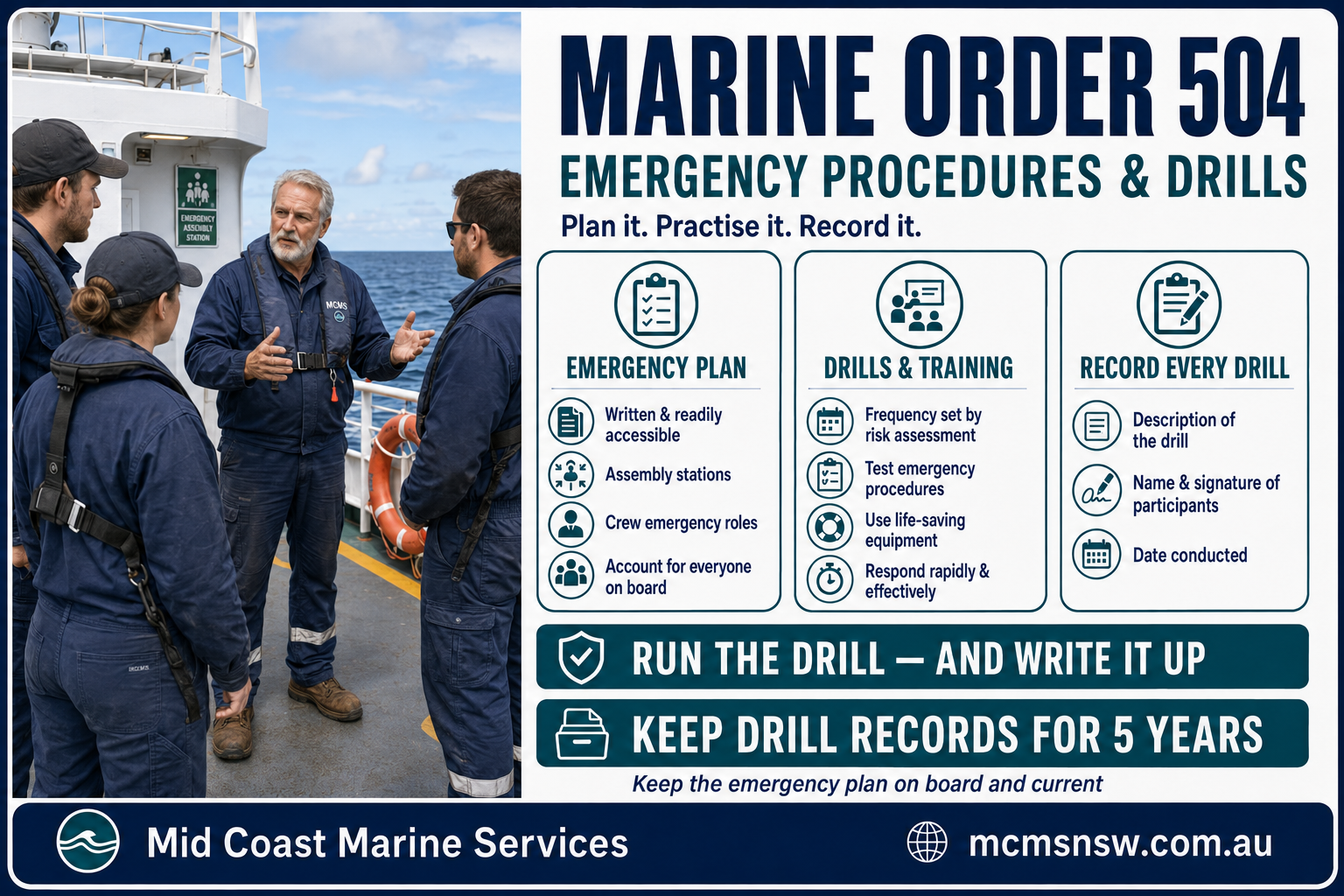
When something goes wrong at sea, there's no time to work out what to do — the plan has to already exist, everyone has to know their part, and you have to have practised it. Marine Order 504 (MO 504, also written MO504) treats emergency preparedness as two linked jobs: a written emergency plan (Schedule 1, clause 12), and the drills and training that prove it works (clause 9).
Written by James Parnell · Published on 8 August 2026 · Source: Australian Maritime Safety Authority (AMSA)
The emergency plan
The owner must make sure the vessel has an emergency plan that is (cl 12(2)): recorded in writing; kept on board and readily accessible; and updated if a review of your risk assessment finds an increased risk.
What the plan must cover
The plan must include a procedure for responding to each of these situations, where relevant (cl 12(3)):
- ▸fire
- ▸a person overboard, or unaccountably missing
- ▸personal injury or other medical emergency
- ▸the master being incapacitated
- ▸loss of steering
- ▸loss of propulsion
- ▸vessel collision
- ▸vessel grounding
- ▸vessel flooding
- ▸oil or fuel spill
- ▸adverse weather or water conditions
- ▸any other circumstance your risk assessment says might need an emergency response
What the plan must identify
Beyond the situation procedures, the plan has to spell out (cl 12(4)): at least one assembly station for everyone on board; where practicable, an alternative assembly station; how each crew member is assigned to an emergency station; and a system for accounting for everyone on board during an emergency.
If you carry passengers
Emergency information must be displayed at each assembly station, in passenger cabins and in areas passengers use — the location of assembly stations, what passengers must do, and how to find, put on and secure a lifejacket (cl 12(5)).
If you carry passengers with a master only, a laminated written or diagrammatic emergency safety procedure must be clearly displayed in a prominent position where practical (cl 12(6)).
The part people forget: drills must be carried out — and recorded
A plan on paper isn't preparedness. MO 504 requires you to actually run emergency drills (cl 9(4)): at a frequency set by your risk assessment; and to test the procedures in your emergency plan and confirm the master and crew can respond rapidly and effectively. Your emergency training must also cover the plan's procedures and the use of the vessel's life-saving equipment (cl 9(3)).
And the bit that trips operators up at audit time — those drills must be recorded and kept for five years. The record must include (cl 9(7)): a description of each drill; the name and signature of every person who took part; and the date it occurred.
Two jobs, not one
Run the drill, and write it up — signed and dated. A drill no one can prove happened is, to an inspector, a drill that didn't happen.
A note on Class 4 and lower-complexity vessels
Some detailed emergency-plan requirements are scaled back for Class 4 (hire-and-drive) vessels and lower-complexity vessels — Class 4 vessels have their own arrangements in Schedule 2. For most Class 1, 2 and 3 operators the requirements above apply in full.
Getting it right in practice
- ▸Write the plan for real scenarios on your vessel — the clause 12(3) situations that could actually happen in your operation.
- ▸Make sure everyone knows their emergency station and role before they're needed.
- ▸Drill to the frequency your risk assessment sets, and vary the scenarios.
- ▸Write up every drill with the scenario, who took part (signed), and the date — and keep it for five years.
- ▸Keep the plan on board and current; re-drill after you change a procedure or add equipment.
Doing it the easy way
The SMS Marine app is built for exactly this. Keep your emergency plan against each vessel in the Emergency Plans section, and use Training & Drills to record every drill — the scenario, the attending crew, who ran it and the date — as a permanent, retained record you can print for an inspector. Your last-drill date even shows on the dashboard, so you can see when the next one is due.
Ready to get your emergency plan and drills sorted?
SMS Marine keeps your emergency plan, drill records and training history in one place — ready to print for an inspector, and always up to date. Compliance without the paperwork headache.
This article is general guidance only. For the full requirements, always refer to Marine Order 504 (MO 504) and AMSA directly.