Fatigue Risk Management Under Marine Order 504: What the New AMSA Requirement Means for Your Vessel
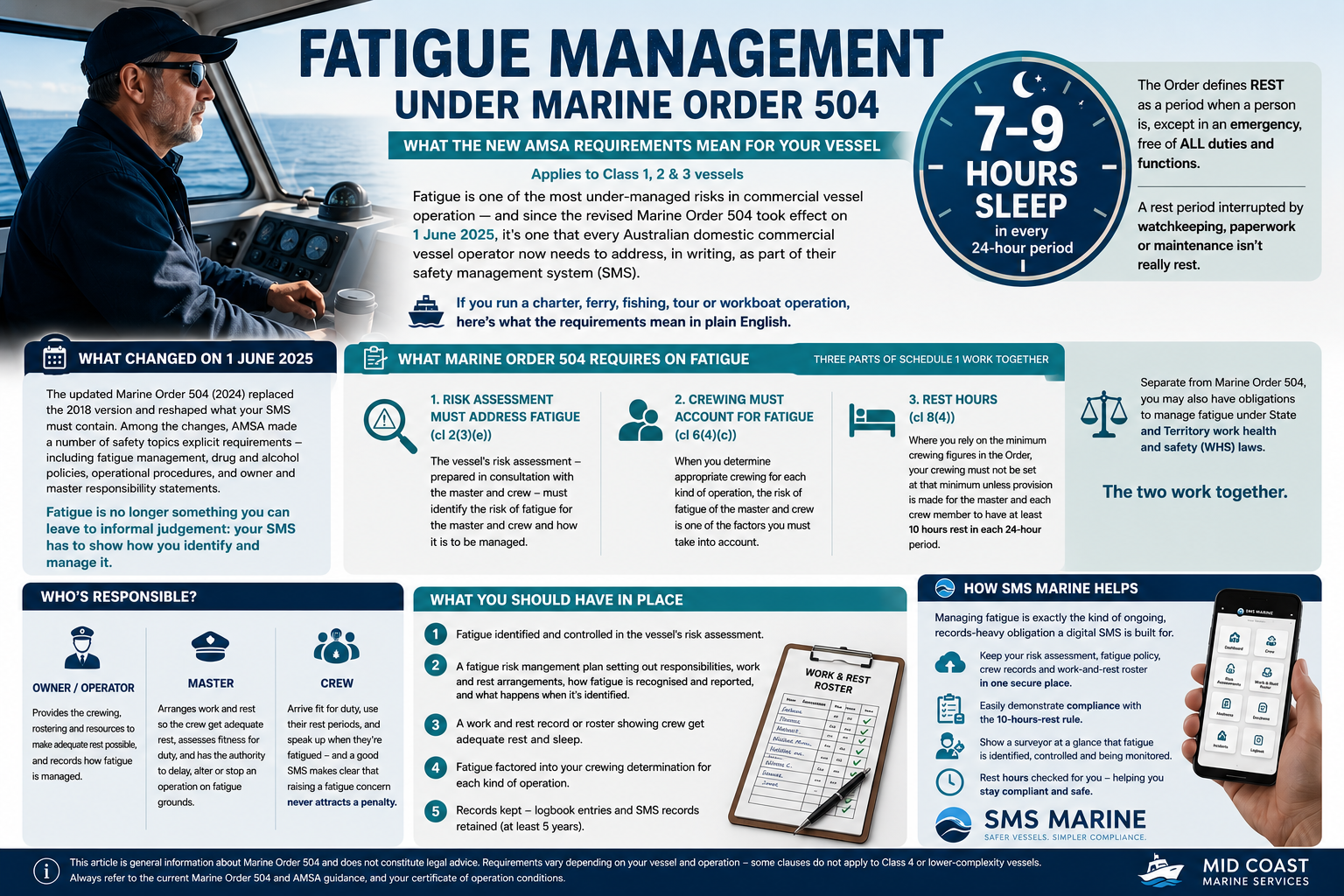
Fatigue is one of the biggest safety risks in commercial vessel operation — and since the revised Marine Order 504 (MO 504, also written MO504) took effect on 1 June 2025, managing it is no longer optional. AMSA now requires owners of Class 1, 2 and 3 vessels to include a fatigue risk management plan in their safety management system (SMS). Here's what that means, and how to comply.
What the requirement actually is
Under the updated MO 504, a fatigue risk management plan is a mandatory part of your SMS for Class 1, 2 and 3 vessels. The plan must identify the risks of master and crew fatigue, and set out how you will manage those risks.
It has to be appropriate to the size and complexity of your vessel, crew and operations — a small charter operator's plan can be short and simple, while a multi-day fishing operation's will be more detailed. (Class 4 and lower-complexity vessels are treated differently — check how each requirement applies to your vessel.) Any obligations you have under State or Territory work health and safety (WHS) laws continue to apply as well.
Why AMSA is focused on it
Fatigue is a hazard like any other, and it sits behind a lot of serious incidents. In one AMSA case, a lone operator returning to anchorage in poor weather had been working 17 hours without rest, fell asleep at the helm, and the vessel travelled 800 metres unattended before running aground and being abandoned. Fatigue makes people slower to react, more likely to miss checks and alarms, and more likely to make poor decisions or lose control of the vessel — with long-term health effects on top.
Who's responsible — everyone
Owners provide a safe working environment and the rest and recovery time crew need; identify fatigue risks; include them in the vessel risk assessment; document how fatigue is managed in the SMS; develop the plan with the master and crew; and implement it, train crew and monitor.
Masters contribute to the risk assessment and the plan, and apply and monitor the controls during operations.
Crew contribute to the plan, follow it, take rest and recovery opportunities when given, and report fatigue concerns promptly.
AMSA's five steps to manage fatigue
- Train everyone — owners, masters and crew.
- Build your fatigue risk plan.
- Put it into action and train your crew to use it.
- Test it and monitor it.
- Review and improve the plan.
What good fatigue controls look like
Your plan should put practical controls in place. AMSA's guidance highlights:
- Allow adequate rest and sleep — aim for 7-9 hours' sleep per 24 hours (at least 7 hours uninterrupted).
- Watch the body clock: the highest-risk window is 2 am to 6 am, with a secondary dip in mid-afternoon. Avoid having people awake and working through that circadian low where you can, and favour daylight hours for demanding tasks.
- Set a maximum number of hours anyone works in a 24-hour period, schedule regular breaks, and plan work to avoid excessive fatigue.
- Provide suitable sleeping conditions — dark, well-ventilated and comfortable.
- Make sure you have sufficient crew, and factor fatigue into your crewing.
- Establish safe fatigue conversations so crew can raise concerns without penalty.
AMSA's fatigue checklist also flags warning signs to design out — anyone regularly working more than 12 hours, more than 60 hours a week, having less than 10 hours' continuous rest between work periods, doing night work between 2-6 am, or not getting at least 24 continuous hours off per week.
Monitor and review
A plan isn't "done" once it's written. Owners and operators should regularly ask: are the master and crew getting enough sleep? Are sleep disorders or distractions affecting rest? Have there been incidents or near-misses where fatigue was a factor? Are the controls still working, or does the plan need amending? Update your SMS whenever your risks or operations change, and learn from incidents.
How SMS Marine helps
A fatigue risk management plan is exactly the kind of live, records-based obligation a digital SMS is built for. SMS Marine keeps your fatigue risks, controls, crew records and work-and-rest roster together — so you can build the plan, put it into action, monitor rest hours, and show a surveyor at a glance that fatigue is identified, controlled and reviewed.
Useful AMSA resources
AMSA provides free tools to help you build your plan, including a fatigue risk management checklist, "how to write a fatigue risk management plan" guidance, a short fatigue management plan template, and crewing guidance. Find them at amsa.gov.au/fatigue.
This article is general information about Marine Order 504 and does not constitute legal advice. Requirements depend on your vessel class and operation. Always refer to the current Marine Order 504, AMSA's fatigue guidance, and your certificate of operation conditions.