Resources · Compliance
Marine Incident Reporting for Marine Order 504 (MO 504, also written MO504) Operators: What You Must Report, and When
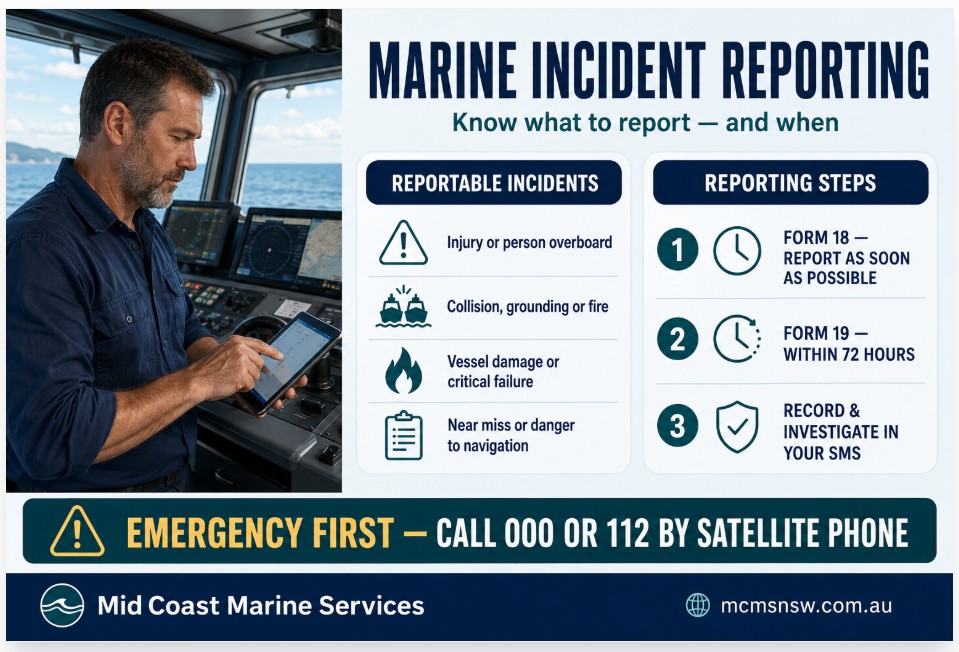
If you run a commercial vessel in Australian waters, the law requires you to report certain incidents to AMSA — often within tight timeframes. Here's a plain-English guide to what you must report, when, and how.
Written by James Parnell · Published on 3 August 2026 · Source: Australian Maritime Safety Authority (AMSA)
Who has to report?
Under the national maritime laws, the duty to report a marine incident falls on the people closest to running the vessel. For a domestic commercial vessel (DCV) that generally means the owner and the master. Depending on the vessel and voyage, the obligation can also extend to the operator, agent, pilot or pilotage provider. In short: if you own or command a commercial vessel and something on this page happens, the responsibility to notify AMSA is yours — it doesn't transfer to someone else because you assume they'll do it.
What counts as a "marine incident"?
These are the matters defined as reportable under the Marine Safety (Domestic Commercial Vessel) National Law. A marine incident means any of the following:
- ▸A death of, or injury to, a person associated with the operation or navigation of the vessel
- ▸The loss, or presumed loss, of the vessel
- ▸A collision with another vessel
- ▸A collision with an object (for example a wharf, a navigation mark or a submerged object)
- ▸The grounding, sinking, flooding or capsizing of the vessel
- ▸A fire on board
- ▸A loss of stability that affects the safety of the vessel
- ▸A structural failure of the vessel
- ▸A close-quarters situation (a near miss)
- ▸Any event that resulted in — or could have resulted in — a death or injury, a person being lost from the vessel, or the vessel being disabled and needing assistance
- ▸The fouling or damaging of a pipeline, submarine cable or aid to navigation by the vessel
- ▸Any other prescribed incident involving the vessel
The near-miss trap
Notice that an event which could have caused death, injury or loss is reportable even if, in the end, nobody was hurt and nothing was damaged. Many operators under-report because "it turned out fine." The law looks at what could have happened, not just what did.
When do you have to report?
Reporting to AMSA is a two-step process, and each step has its own timeframe:
Notify — Form 18 (Incident Alert)
Report to AMSA as soon as possible after you become aware of the incident. This is the quick, early notification.
Complete Form 18 online →Report — Form 19 (Incident Report)
Submit the detailed written report within 72 hours. All commercial vessels involved in a marine incident in Australian waters must lodge a Form 19.
Complete Form 19 online →In an emergency, safety comes first
If life or the vessel is in immediate danger, dial 000 (or 112 from a satellite phone) before anything else. Incident paperwork follows once people are safe.
How to report
Reports are made to AMSA using their official forms — Form 18 for the initial alert and Form 19 for the full report. Each can be completed online or downloaded as a PDF and emailed to AMSA. There's also a separate channel for reporting marine pollution and Form 355 for raising a marine safety concern. Keep a copy of everything you submit for your own records.
Quick Reference
- ▸Form 18 — Incident Alert: notify AMSA as soon as possible
- ▸Form 19 — Incident Report: full written report within 72 hours
- ▸Form 19 is required for all commercial vessels involved in a marine incident
- ⚠Emergency — 000, or 112 by satellite phone
The legislation behind it
These obligations aren't discretionary — they sit in Commonwealth law. Depending on your vessel and operation, the relevant provisions include:
- ▸Marine Safety (Domestic Commercial Vessel) National Law Act 2012 — ss 88–89
- ▸Navigation Act 2012 — ss 185–186
- ▸Occupational Health and Safety (Maritime Industry) Act 1993 — s 107
- ▸Transport Safety Investigation Act 2003 — ss 18–19
- ▸Transport Safety Investigation Regulations 2021 — Part 3
Not sure your reporting process is up to scratch?
SMS Marine builds incident reporting straight into your Safety Management System — so when something happens, your crew knows exactly what to log, which form to lodge, and by when. Compliance without the complexity.
Explore SMS MarineThis article is a plain-English summary prepared by Mid Coast Marine Services for general guidance only. It is not legal advice and does not replace the official requirements. Reporting obligations depend on your specific vessel, operation and circumstances, and the rules can change. Always confirm your current obligations directly with the Australian Maritime Safety Authority at amsa.gov.au or seek professional advice.