
MID COAST MARINE SERVICES | RESOURCES
What Must (and Can) Go in Your Vessel's Logbook Under Marine Order 504
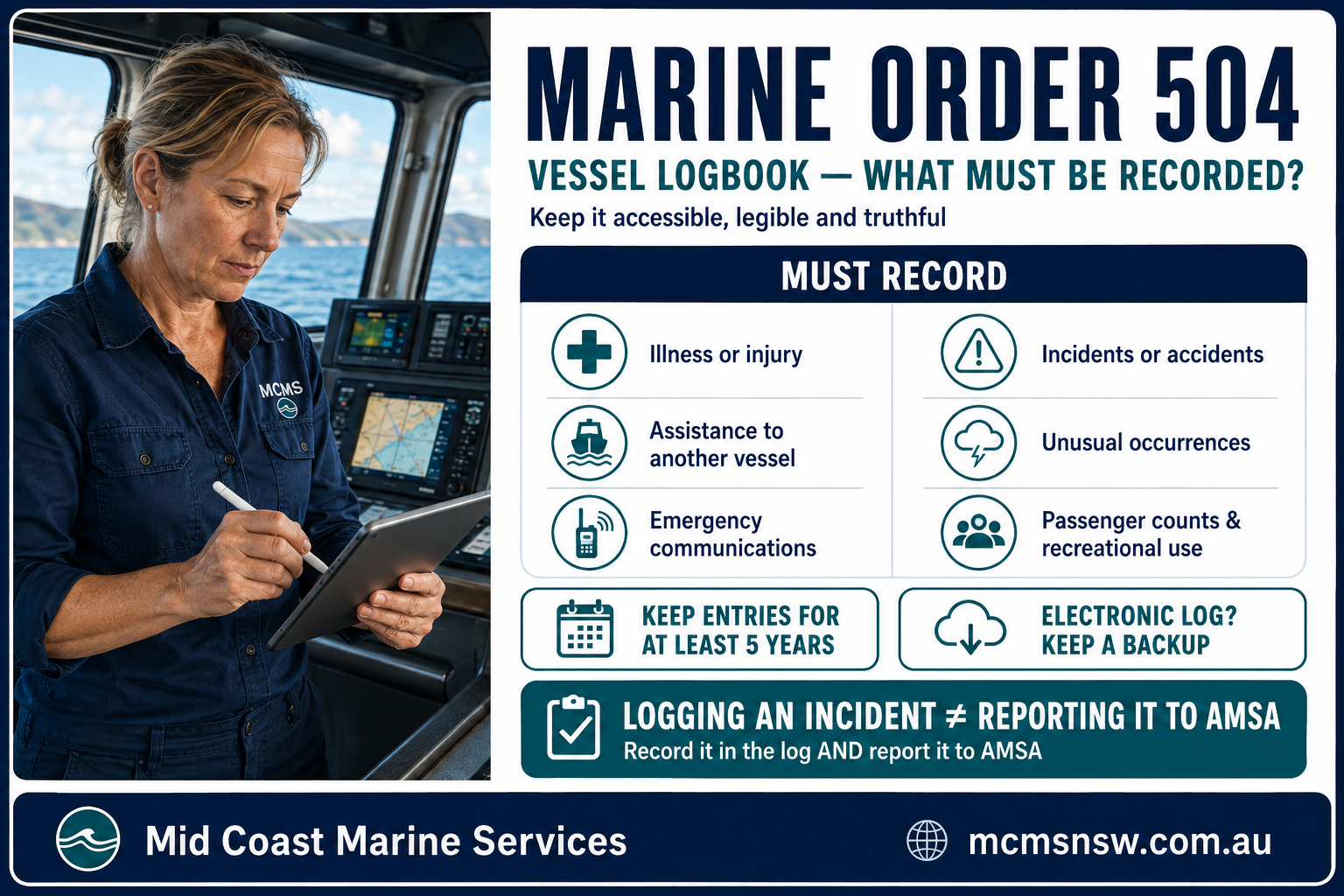
The logbook is one of the simplest records in your safety management system — and one of the easiest to get pinged on if a marine safety inspector asks to see it. Marine Order 504 (MO 504) doesn't hand you a rigid template, but it is clear about what the book has to contain, how it has to be kept, and how long you have to hold on to it. Here's the plain-English version.
First, the basics
MO 504 (Schedule 1, clause 15) says the owner or master must make sure a logbook is kept for the vessel, and that it is:
- readily accessible — either on board or on shore;
- legible — someone else has to be able to read it; and
- truthful — it must not contain false or misleading information.
The order deliberately doesn't specify a format. It can be a paper book or an electronic log — that's your call. If you keep it electronically, you must have a back-up arrangement so the information can't be lost.
One thing worth knowing: if a marine safety inspector or the National Regulator asks to see the logbook, you have to produce it. Failing to do so is an offence under the national law.
What you MUST record
This is the part people miss. The master has to make sure the logbook records details about each of the following (clause 15(4)):
- Illness or injury of a person on board.
- A marine incident, other incident or accident involving the vessel or its machinery and equipment.
- Assistance rendered to another vessel.
- Any unusual occurrence or incident.
- Emergency communications — any message sent or received for an emergency.
- Passenger counts — each count you conduct, if you're carrying passengers.
- Recreational operations — any use of the vessel for recreational purposes.
And there's a timing rule: information about an unusual occurrence or incident must be recorded as soon as practicable after it happens (clause 15(5)) — not written up from memory a week later.
What you CAN record
Beyond the mandatory list, the order says the logbook may record any details the master considers relevant. In practice, that's where good operators capture the day-to-day story of the vessel, including:
- key operations carried out;
- the vessel's position;
- the navigation track; and
- the weather experienced.
None of these four are strictly required by clause 15 — but they're exactly the kind of detail that protects you if something is ever questioned, and most surveyors expect to see a working logbook that tells the story of the voyage, not just a list of incidents. If in doubt, write it down.
How long you keep it
Every logbook entry must be retained for at least 5 years after it's made (clause 15(6)). That applies whether the entry is on paper or electronic — so your back-up arrangement needs to cover that whole period, not just the current season.
One important trap: logging an incident is not reporting it
Writing a marine incident in your logbook is a good habit and part of your record-keeping — but it is not the same as reporting the incident to AMSA. Under the national law, the owner or master must still report a marine incident (that's the Form 18 / Form 19 process), and failing to do so is a separate offence. Think of it as two jobs: record it in the log, and report it to AMSA.
A note on Class 4 and lower-complexity vessels
Clause 15 doesn't apply to Class 4 (hire-and-drive) vessels, and some parts — the passenger-manifest requirements and a few of the crew-list details — don't apply to lower-complexity vessels. If that's you, check the applicability notes in Schedule 1, but for most Class 1, 2 and 3 operators the logbook duties above apply in full.
Getting it right in practice
- Keep it current. Record unusual occurrences as soon as practicable — same day, not from memory later.
- Keep it legible and honest. A book no one can read, or one with tidied-up entries, is worse than useless.
- Back up electronic logs, and make sure the back-up covers the full 5-year retention period.
- Use one consistent format so nothing gets missed and an inspector can follow it easily.
Doing it the easy way
This is exactly what the Logbook feature in the SMS Marine app is built for. You record each entry — voyage details, crew on board, events, passenger counts and incidents — in one consistent, legible format, and because it's cloud-based, your entries are automatically backed up and retained. When an inspector asks for the log, it's all there, readable and in order, rather than a water-damaged book in the wheelhouse.
This article is general guidance only. For the full requirements, always refer to Marine Order 504 and AMSA directly.