
Resources · Compliance
Procedures and Policies for Vessel Operations Under Marine Order 504 (MO 504)
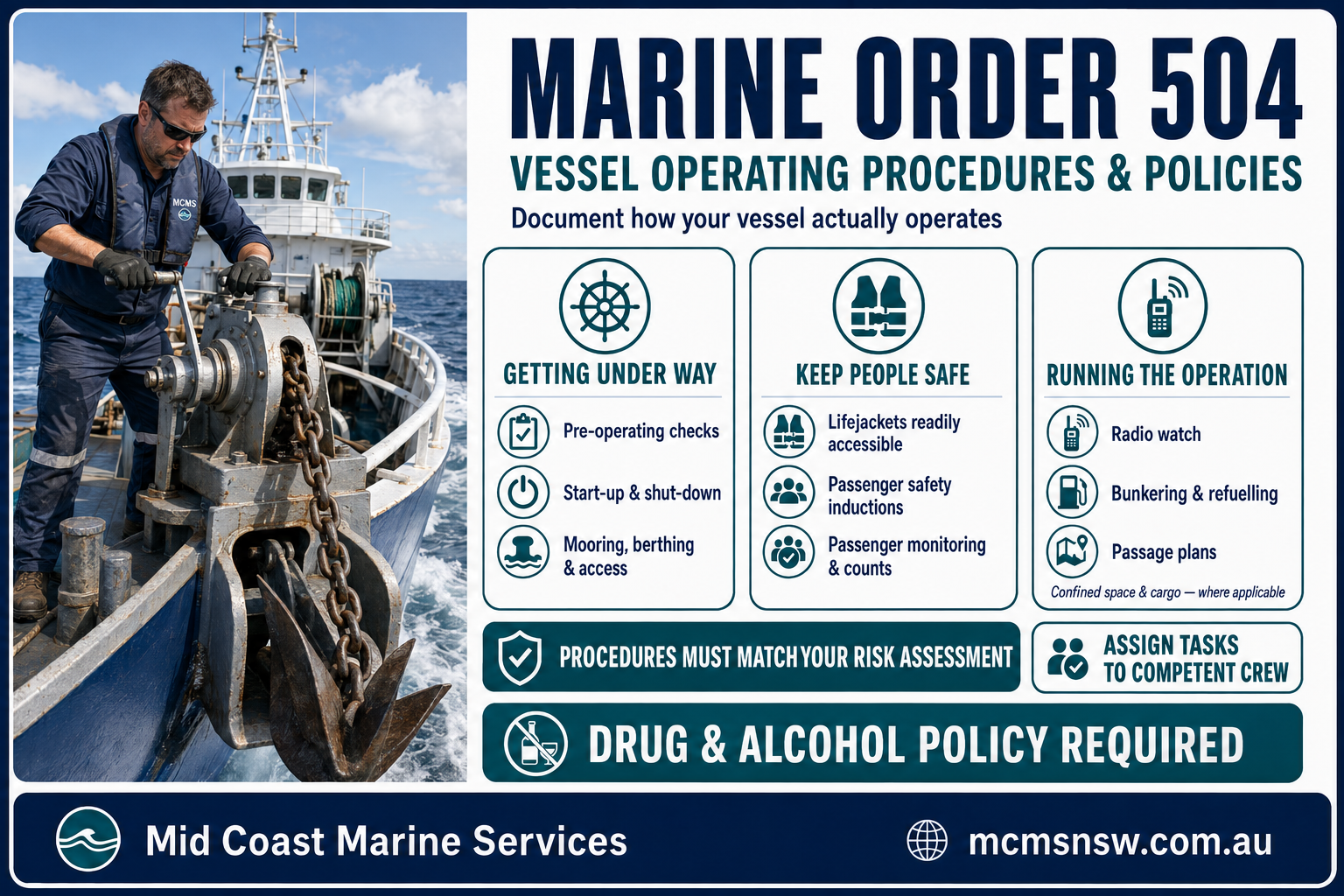
Your safety management system isn't just a folder of records — at its heart it's a set of written procedures that tell your crew how to run the vessel safely, and a couple of policies that set the ground rules. Marine Order 504 (MO 504) is specific about what those procedures have to cover. Here's the plain-English version of what Schedule 1, clause 11 asks for.
The core requirement
The owner must make sure there is a documented procedure covering the safety of the vessel, the environment and the people on or near it — recorded so it is readily accessible (cl 11(2)). Those procedures must (cl 11(3)): be developed for your key vessel operations; address the risks identified in your risk assessment; and, if a review of the risk assessment finds an increased risk, set out how you will change things to reduce or eliminate that risk so far as reasonably practicable. Each task in a procedure must be assigned to crew who have the skills and knowledge to do it (cl 11(4)). Your procedures and your risk assessment are joined at the hip — the risk assessment says what could go wrong; the procedures say how you manage it.
The procedures you must have (where they apply)
Clause 11(5) lists the procedures you need, if they apply to your vessel and operation:
Getting under way
- ▸Pre-operating checks.
- ▸Vessel start-up and shut-down.
- ▸Mooring and berthing.
- ▸The means of getting on and off the vessel (access).
Keeping people safe on board
- ▸Wearing of lifejackets — taking account of the risks in your risk assessment, and managing lifejackets so they are readily accessible at all times.
- ▸For vessels carrying passengers: giving each passenger a safety induction about the relevant operational and emergency procedures, including how to wear a lifejacket, as soon as practicable after they board.
- ▸Passenger monitoring — an effective, verifiable way to always know how many people are on board (Class 1 and permitted Class 2 vessels).
- ▸Passenger counts at embarkation and disembarkation, and an extra count around water-based activities where those apply.
Running the operation
- ▸Keeping a radio watch, unless an exception applies.
- ▸Bunkering and refuelling.
- ▸Preparing and using passage plans.
- ▸Confined space entry, if your vessel has any confined space.
- ▸Cargo operations, including the carriage of dangerous goods, if you carry cargo.
You don't need every one — only the ones relevant to how your vessel actually operates.
Don't forget the drug and alcohol policy
Separately, the owner must ensure there is a drug and alcohol policy that addresses how the risks of drug and alcohol use are managed (cl 11(6)). It's a policy, not just a procedure, and it's an easy item to be caught without.
A note on Class 4 and lower-complexity vessels
The main procedure-building requirements (subclauses (4) and (5)) don't apply to Class 4 (hire-and-drive) vessels — which have their own arrangements in Schedule 2 — and several specific procedures don't apply to lower-complexity vessels. For most Class 1, 2 and 3 operators, the full list is in play.
Getting it right in practice
- ▸Write procedures for how your vessel actually works — not a generic download with someone else's boat in it.
- ▸Tie each procedure back to your risk assessment.
- ▸Assign every task to a competent crew member, so it's clear who does what.
- ▸Keep them readily accessible where the crew will actually use them.
- ▸Review them when your operation changes or a risk review flags something new, and record the revision.
Doing it the easy way
The SMS Marine app gives you a home for all of this — an Operational Procedures section to hold your documented procedures against each vessel, and a document library with ready-to-tailor Marine Order 504 templates and policies (including a drug and alcohol policy, confined space permit, and bunkering and refuelling checklist) so you're editing a solid starting point rather than a blank page. Everything stays readily accessible, version-controlled and audit-ready.
This article is general guidance only. For the full requirements, always refer to Marine Order 504 and AMSA directly.