Resources · Compliance
Drug and Alcohol Policy Requirements for Commercial Vessels: What Your SMS Must Cover
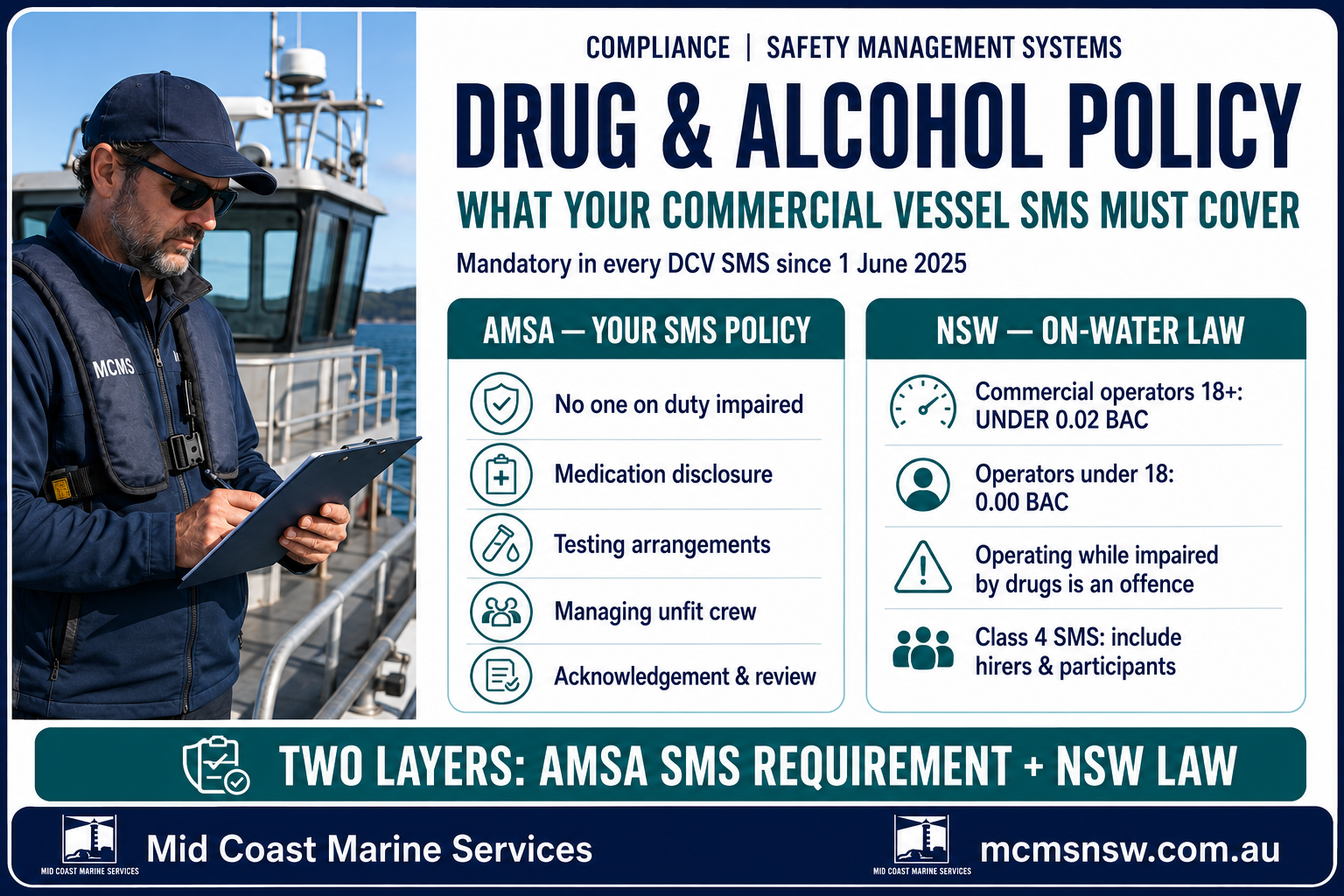
Impairment on the water is a safety risk you can't afford — a moment's poor judgement near machinery, in a channel, or in a swell can end badly. That's why a drug and alcohol policy is now a mandatory part of every domestic commercial vessel (DCV) safety management system (SMS). Under the changes to Marine Order 504 (MO 504, also written MO504) that took effect on 1 June 2025, AMSA requires your SMS to set out, in writing, how you keep drugs and alcohol from compromising safety on board. Importantly, there are two separate layers of obligation and you must meet both: AMSA's SMS requirement (the written policy) and NSW state law (the actual blood-alcohol limits enforced on the water).
Written by James Parnell · Published on 18 August 2026 · Source: Australian Maritime Safety Authority (AMSA)
Layer 1 — The AMSA requirement (your SMS policy)
AMSA doesn't provide a fixed template or a single blood-alcohol number to insert. Your policy must be appropriate to the size and complexity of your operation — a solo owner-operator can have a short, clear statement; a larger crewed operation needs more detailed procedures. What matters is that the policy genuinely manages the risk.
What a policy should cover — Class 1, 2 and 3
- ▸Acceptable and unacceptable use — e.g. whether the vessel is strictly “dry”, and how prescription/over-the-counter medications are handled.
- ▸Disclosure — requiring crew to declare prescription medications and side effects that could affect fitness for duty.
- ▸Testing — whether you'll test, e.g. before crew board as part of pre-departure checks.
- ▸Managing someone unfit for duty — how an impaired crew member is stood down and duties covered.
What a policy should cover — Class 4 (hire and drive)
Hire-and-drive operators must address both staff and hirers:
- ▸For staff — medication disclosure, any pre-departure testing, and denying duty to anyone unfit.
- ▸For hirers and participants — acceptable consumption limits aligned with state law, any required medical disclosure, a clear acknowledgement of the rules at handover, and a procedure for a hirer who appears impaired.
The level of detail scales with your operation — a concise policy is fine for a simplified SMS, provided it addresses these points.
Layer 2 — NSW on-water alcohol and drug laws
Your SMS policy sits on top of NSW law, which sets the enforceable limits. On NSW waters, operating (or attempting to operate) a vessel while affected by alcohol or drugs is an offence, and police and Transport for NSW can breath-test and drug-test operators.
- ▸Commercial operators — a stricter “special range” applies, meaning a commercial master or operator must effectively stay below 0.02 BAC while in charge of the vessel.
- ▸Operators under 18 — must maintain zero (0.00) BAC.
- ▸General limit — the recreational low-range offence begins at 0.05, but commercial crews should not rely on this higher figure.
Penalties escalate by range, from fines and disqualification up to possible imprisonment at mid and high ranges. The master carries separate liability: permitting an impaired person to operate the vessel is itself an offence. Drug offences apply alongside the alcohol limits.
Practical takeaway
Build your SMS policy around a "below 0.02 / effectively zero for anyone on duty" standard — simple to enforce, aligned with the commercial limit, and protective of both crew and operator.
Writing a drug and alcohol policy that actually works
- 1.Set a clear standard — no one operates or crews while affected; specify the limit (zero / below-0.02 for anyone on duty).
- 2.Cover medications — require disclosure of prescription and OTC medicines that could impair.
- 3.Decide on testing — even if not routine, state when you might test (pre-departure, after an incident).
- 4.Spell out consequences — what happens when someone is unfit, and how the trip is managed safely.
- 5.Get acknowledgement — have crew (and, for hire-and-drive, hirers) acknowledge the policy.
- 6.Keep it current — review periodically and after any drug- or alcohol-related incident.
Common pitfalls to avoid
- ▸Copying a generic template that doesn't match how you operate.
- ▸Relying on the 0.05 recreational figure when commercial operators are held to a stricter standard.
- ▸Forgetting hirers — Class 4 operators must address the people they hand the boat to.
- ▸No record of acknowledgement — if it isn't documented, it's hard to show you managed the risk.
How MCMS can help
At Mid Coast Marine Services we help owner-operators, fishers and hire-and-drive businesses across the NSW coast build drug and alcohol policies that satisfy AMSA, align with NSW law, and are practical to run day to day. Whether you need a concise policy for a simplified SMS or fuller procedures for a crewed operation, we can draft it around how you actually work.
Need a drug and alcohol policy that fits your operation?
Tell us how you operate and we'll draft a policy that satisfies AMSA and works day to day on your vessel.
Talk to MCMS about your SMSThis article is general information current as at August 2026 and is not legal advice or a substitute for AMSA's official requirements. Blood-alcohol limits, offences and penalties are set by legislation and can change — always confirm current obligations with AMSA (amsa.gov.au), Transport for NSW, and Marine Order 504, or speak with MCMS.