What is Marine Order 504? A Plain-English Guide
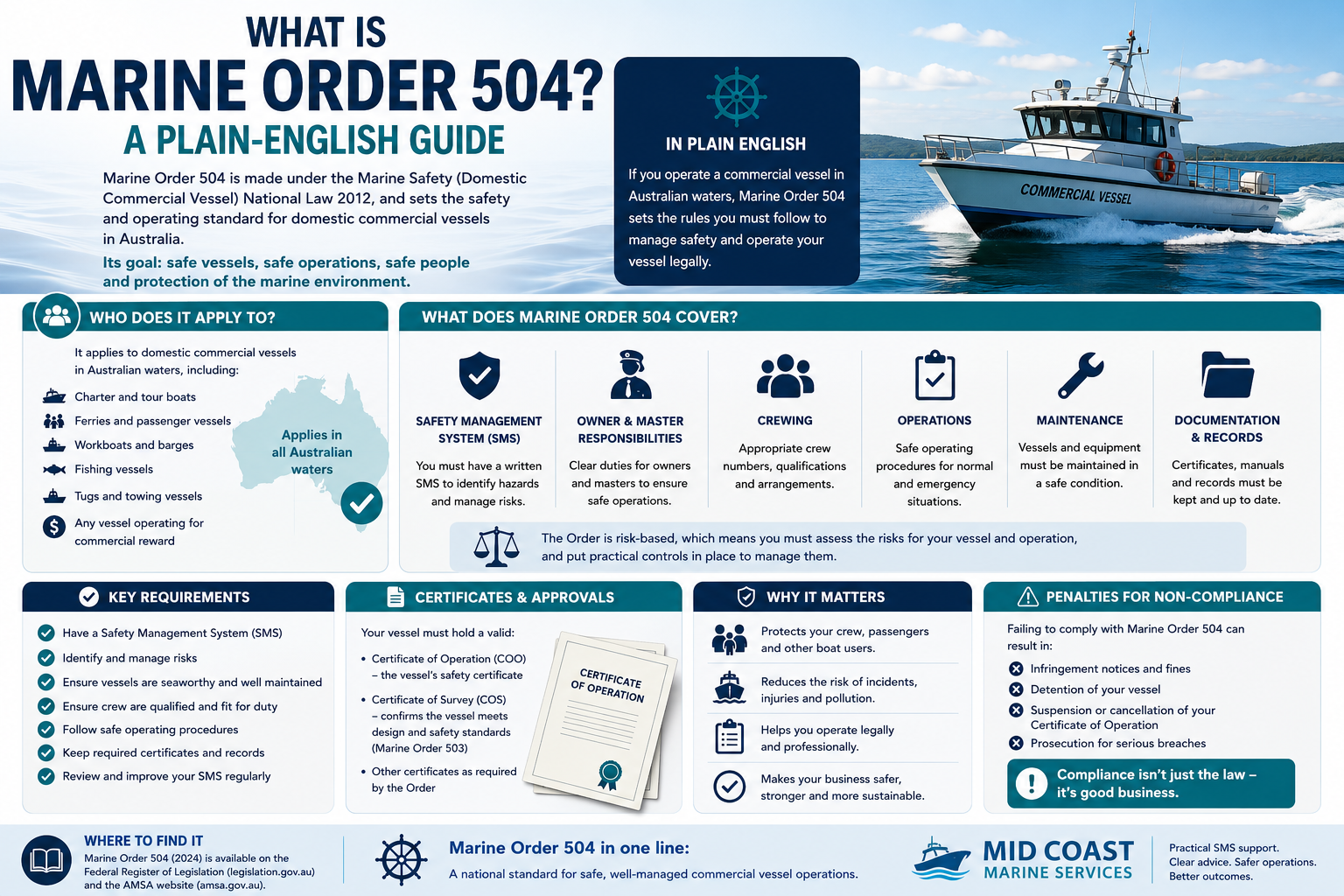
If you run a commercial vessel in Australia, you'll have heard of Marine Order 504 (MO 504, also written MO504) — usually as the reason you need a "safety management system." But what actually is it, who does it apply to, and what does it require? Here's the plain-English version.
What is Marine Order 504?
Marine Order 504 is the Australian rule that sets out what a domestic commercial vessel needs in order to operate legally and safely. It's made by the Australian Maritime Safety Authority (AMSA) under the Marine Safety (Domestic Commercial Vessel) National Law, and its full title is Marine Order 504 (Certificates of Operation — National Law) 2024.
In practical terms, it covers two things: the certificate of operation your vessel needs, and the safety management system (SMS) you must have in place to get and keep it.
For a clear explanation of how the certificate of operation differs from a vessel’s certificate of survey, see our certificate of survey vs certificate of operation guide.
A domestic commercial vessel is, broadly, any vessel used for a commercial, governmental or research purpose in Australian waters — charter boats, ferries, fishing vessels, tour operators, workboats, hire-and-drive craft and the like.
What changed on 1 June 2025?
The current version, MO 504 (2024), replaced the 2018 version and took effect on 1 June 2025. It reshaped what your SMS must contain and made several safety topics explicit, mandatory requirements — including fatigue management, drug and alcohol policies, documented operational procedures, and owner and master responsibility statements. If your SMS was built under the old rules, it's worth reviewing against the new ones.
The two things it requires
- A certificate of operation. Most domestic commercial vessels need a certificate of operation to work commercially. To get one, you apply to AMSA and state, in writing, that a safety management system is in place for each vessel.
- A safety management system (SMS). This is the heart of MO 504. Your SMS is the documented system that shows how you run your vessel safely — your risks, your procedures, your people and your records. It must be recorded, readily accessible (on board where practicable and onshore) and kept up to date.
What your SMS must include
For Class 1, 2 and 3 vessels, Schedule 1 of MO 504 sets out the operation requirements your SMS has to cover. In plain terms, that's:
- Vessel and owner details — who owns and operates the vessel, its identifier, class and area of operation, and a contact who can be reached at any time.
- A risk assessment — prepared with the master and crew, identifying your hazards (including fatigue), how they're controlled, who's responsible, and when a lifejacket must be worn.
- Responsibility statements — an owner's responsibility and authority statement, a designated person (your shore-based safety contact), and a master's responsibility and authority statement.
- Appropriate crewing — the right number and competency of crew for each operation, taking account of fatigue and rest.
- Training, drills and induction — safety training and familiarisation for crew, plus emergency drills at a frequency set by your risk assessment.
- First aid and radio — a qualified first-aider and someone able to operate the radio.
- Procedures and policies — documented procedures for your key operations, plus a drug and alcohol policy.
- An emergency plan — covering the emergencies relevant to your vessel, with assembly stations and crew roles.
- Hazardous occurrences and non-conformances — investigated and recorded, with corrective action.
- Maintenance — a system of regular inspection and maintenance of the vessel and its equipment.
- Logbooks and records — a logbook, plus (where relevant) a passenger manifest and crew list; records kept for at least 5 years.
- Review and revision — a system to review your procedures (at least every 12 months) and record changes.
What about smaller and hire-and-drive vessels?
Marine Order 504 is scaled to the vessel. Smaller and lower-complexity vessels have fewer requirements, and some operators can use a simplified SMS. At the other end, Class 4 (hire-and-drive) vessels — such as jet-ski and personal-watercraft hire — have additional requirements in Schedule 2, covering things like designated cruising areas, participant briefings, and competency and age rules.
What happens if you don't comply?
Your SMS isn't a "file it and forget it" document — it's a condition of your certificate of operation. AMSA can ask to see your records, and a marine safety inspector can review your SMS during an inspection. Failing to have a compliant SMS, or not keeping the required records, can put your certificate at risk and carries penalties under the national law. Just as importantly, the whole point of the system is to prevent the incidents that hurt people and damage vessels.
How to get started
If you're setting up or updating your SMS, work through Schedule 1 point by point, tailor everything to your actual vessel and operation (there's no one-size-fits-all), and keep it current. A digital SMS makes this far easier — SMS Marine gives you the whole Marine Order 504 system in one place: vessels, crew and certificates, risk assessments, drills, maintenance, logbooks, incidents and audit-ready reports — so you can show a surveyor at a glance that you're compliant.
See how our commercial vessel compliance software helps operators keep the documents, records and review processes that support their Marine Order 504 safety management system in one place.
Useful resources
AMSA publishes plain-English guidance, checklists and templates for building your SMS. Find them at amsa.gov.au.
This article is general information about Marine Order 504 and does not constitute legal advice. Requirements depend on your vessel class and operation. Always refer to the current Marine Order 504, AMSA guidance, and your certificate of operation conditions.