MID COAST MARINE SERVICES | RESOURCES
Certificate of Survey vs Certificate of Operation: What’s the Difference?
Last updated: 19 September 2026
These two certificates get mixed up more than any other pair of documents in domestic commercial vessel compliance — and it’s easy to see why. Both are issued by AMSA. Both have to be in place before you work the boat. Both sound like they mean roughly the same thing. But a certificate of survey and a certificate of operation do genuinely different jobs, and confusing them causes real problems, particularly when a vessel changes hands. Here’s the difference in plain English.
The short answer
The simplest way to hold it in your head:
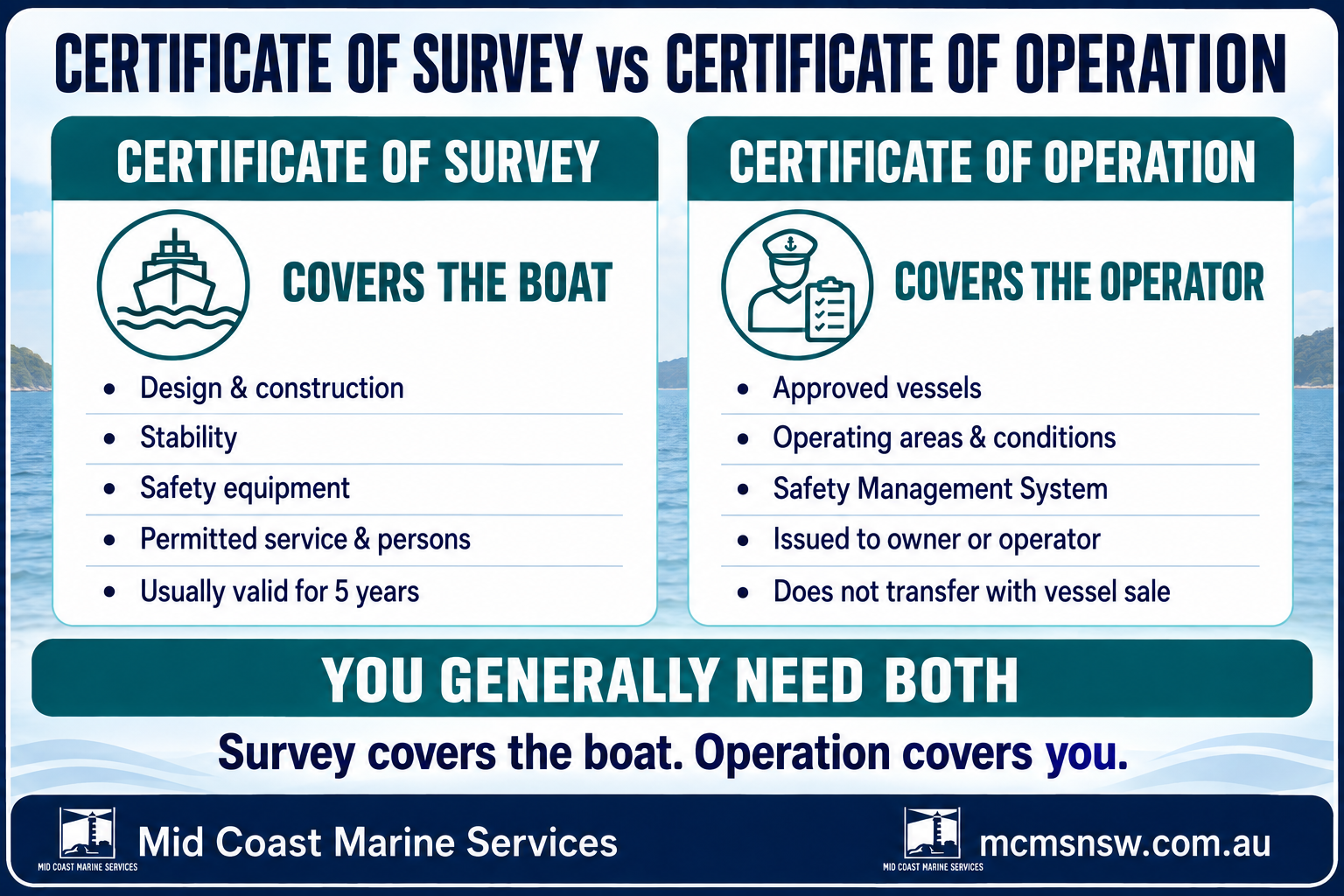
- A certificate of survey covers the boat. It says the vessel itself is built, equipped and maintained to standard.
- A certificate of operation covers you. It says who is operating, which vessels they’re operating, where, and under what safety management system.
One is about steel, glass and machinery. The other is about the business and how it’s run. You generally need both, and getting one does not get you the other.
What a certificate of survey covers
A certificate of survey certifies that your vessel meets the design, construction, stability and safety equipment standards required for the work it does.
To get one, the vessel is surveyed by an AMSA accredited marine surveyor. Vessels of 35 metres or more generally need a recognised organisation rather than an individual surveyor. AMSA then issues the certificate, which sets out the vessel’s permitted service categories and the number of crew, passengers and special personnel it may carry, along with any conditions specific to that vessel.
Certificates of survey are normally valid for five years, with periodic inspections through that period.
Not every vessel needs one. Exemptions cover things like small vessels operating in sheltered waters with few passengers, human-powered craft such as kayaks and canoes, small sailing vessels, vessels used for recreational training, volunteer marine rescue and fire service vessels, some vessels under 12 metres in specified near-shore areas, tenders and auxiliary vessels, and existing vessels that didn’t require a certificate of survey before 30 June 2013.
What a certificate of operation covers
A certificate of operation is about the operation, not the hull. It sets out which vessels you’re authorised to operate, the geographic areas and operational parameters you’re approved for, the safety management system you’ll run under Marine Order 504, and any other conditions AMSA considers necessary.
The critical point — and the one that catches people out — is who it belongs to. A certificate of operation is issued to the owner or operator, not to the vessel. It is a certificate about a business and the way that business runs boats.
Applications are made on form AMSA 504 for a new certificate or a variation, and form AMSA 553 for a renewal. Certain larger vessels also require a crewing determination as part of the application.
As with survey, there are exemptions — recreational-use vessels, emergency services vessels, unpowered barges, temporary operations and some other categories are covered by AMSA’s published exemptions. Check the current exemption list against your specific operation rather than assuming.
The mistake that catches vessel buyers
This is worth its own heading, because it costs people money every year.
When you buy a domestic commercial vessel, the certificate of survey relates to that vessel and its history follows the boat. The seller’s certificate of operation does not come with it. Certificates of operation can’t be transferred between operators when a vessel changes hands, because they belong to the previous operator’s business, not to the hull.
So if you’ve just bought a boat that was working commercially the day before you signed, you cannot simply carry on where the last owner left off. You need your own certificate of operation, with your own safety management system behind it, before you start work. Build that lead time into your purchase planning — not the week you were hoping to take your first booking.
You still need an SMS even if you’re exempt
Another common misunderstanding. Being exempt from the requirement to hold a certificate of operation does not exempt you from having a safety management system.
AMSA is explicit on this: every domestic commercial vessel requires a documented SMS, even where the vessel is exempt from needing a certificate of operation. If you’ve concluded you don’t need a CoO, your next job is your SMS, not a day off. If your vessel is small and lower-risk, you may be eligible for a simplified SMS, which is a considerably shorter document.
How the pieces fit together
For most operators the sequence runs roughly like this:
- Unique Vessel Identifier (UVI) — the vessel’s identifying number, displayed on the vessel.
- Certificate of survey — the vessel is surveyed and certified as fit for its intended service.
- Safety management system — your documented system for running the vessel safely, under Marine Order 504, including a vessel-specific risk assessment.
- Certificate of operation — your authorisation to operate, with the SMS behind it.
- Crew certificates of competency — the right tickets for the people on board.
Survey establishes that the boat is sound. The SMS establishes how you’ll run it. The certificate of operation ties the two together and puts your name on it.
How MCMS can help
Mid Coast Marine Services works with owner-operators across NSW on safety management systems and AMSA compliance. We can tell you which certificates your operation actually needs, prepare the SMS that sits behind your certificate of operation, and help you get a newly purchased vessel working under your own certificate without unnecessary delay.
For a practical way to keep your SMS, risk assessments and records together, see SMS Marine.
Just bought a boat, or not sure whether you need a certificate of operation at all? Email info@mcmsnsw.com.au and we’ll point you in the right direction.
This article is general information only and does not constitute compliance advice. Requirements are set by AMSA — always confirm your obligations at amsa.gov.au.