Resources · Compliance
Operational Procedures for Commercial Vessels: A Simple Guide to Marine Order 504
Last reviewed: 29 August 2026
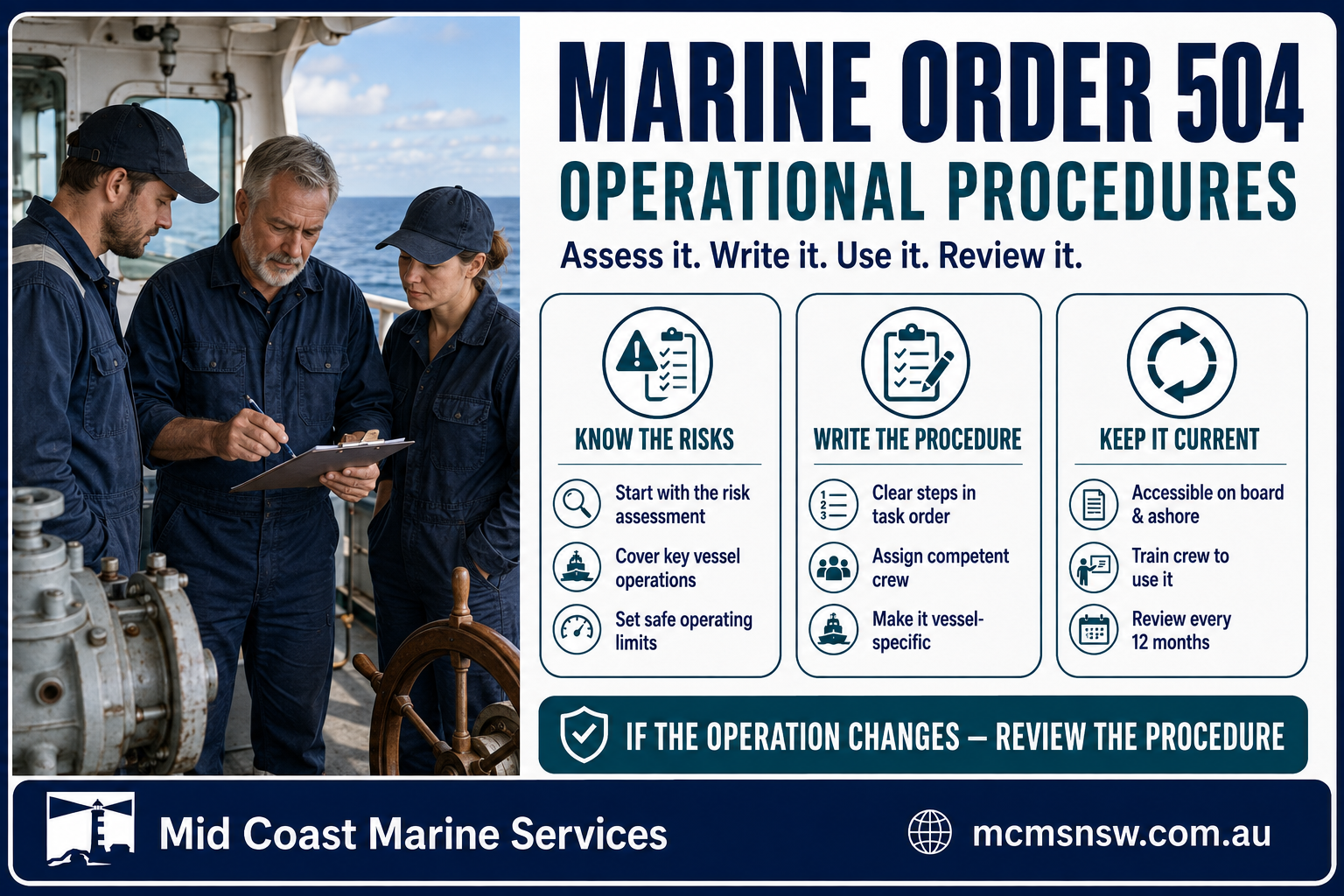
Every domestic commercial vessel must have a Safety Management System that reflects how the vessel is actually operated.
An important part of that system is the vessel's operational procedures. These procedures explain how routine and higher-risk tasks will be carried out safely.
The current Marine Order 504 requirements commenced on 1 June 2025. They apply to domestic commercial vessel owners and operators throughout Australia.
What is an operational procedure?
An operational procedure is a clear set of instructions explaining how a particular vessel operation must be performed.
It should tell the master and crew:
- what must be done
- who is responsible
- the order in which tasks must be completed
- what safety checks are required
- what hazards may be present
- what controls must be used
- when an operation must be stopped
- what records must be completed
A procedure does not need to be complicated. For a small vessel, it may be a short checklist or a series of dot points. A larger or more complex vessel may require a more detailed procedure.
The important point is that the procedure must suit the vessel, its equipment, its crew and the type of work being performed.
What does Marine Order 504 require?
Under Schedule 1, clause 11 of Marine Order 504, the vessel owner must ensure that operational procedures:
- are recorded and readily accessible
- cover the vessel's key operations
- address the hazards identified in the vessel's risk assessment
- explain how increased or newly identified risks will be controlled
- assign tasks to crew members who have the necessary skills and knowledge
The procedures and other required SMS records must generally be available:
- on board the vessel, where practical considering the vessel's size and use
- onshore with the appropriate shore-based personnel
The SMS may be kept electronically, provided it can be reliably accessed when needed.
Which operational procedures are required?
For Class 1, Class 2 and Class 3 vessels operating under a full SMS, procedures must be developed for the following activities where they apply to the vessel:
Use the free Marine Order 504 procedures checklist to work out which procedures apply to your vessel.
Pre-operating checks
Checks completed before the vessel begins operating. These may include fuel, oil, batteries, bilges, steering, machinery, safety equipment, communications, weather and passenger areas.
Vessel start-up and shutdown
The correct sequence for starting machinery, checking alarms and systems, preparing the vessel for operation and safely shutting everything down at the end of the day.
Mooring and berthing
How the vessel approaches and leaves a berth, who handles lines, communication between the master and crew, safe working positions and how crush or fall hazards are controlled.
Access to and from the vessel
How crew, passengers, contractors and visitors safely board and leave the vessel. This should consider gangways, ladders, lighting, handrails, tides, vessel movement and slip or trip hazards.
Lifejacket wearing
The risk assessment must identify when lifejackets are to be worn. The procedure must also explain how lifejackets are kept readily accessible and how crew and passengers are informed of the requirements.
Passenger safety induction
Passenger vessels must have a procedure for providing passengers with relevant operational and emergency safety information as soon as practical after boarding. Group inductions are permitted.
Passenger monitoring
Class 1 vessels and Class 2 vessels permitted to carry passengers must have an effective and verifiable system that allows the master to determine how many passengers are on board at any time.
Passenger counts
Certain passenger vessels and voyages require passenger counts when people embark and disembark. Additional counts may be required before leaving a location where passengers participated in an activity such as swimming, diving or snorkelling.
Radio watch
Where the vessel is required to carry a radio, the procedure should explain which frequencies are monitored, who maintains the watch and the circumstances in which another frequency may be used.
Bunkering and refuelling
This procedure should cover preparation, communication, ignition control, spill prevention, fuel transfer, emergency shutdown, spill response and final checks.
Passage planning
The procedure should explain when a passage plan is required, who prepares and approves it, and how weather, tides, navigation hazards, safe depths, fuel, communications and alternative destinations are considered.
Confined-space entry
If the vessel has a confined space, the procedure must address safe entry. Relevant work health and safety laws, atmospheric testing, permits, isolation, communications, standby personnel and rescue arrangements must also be considered.
Cargo operations and dangerous goods
If the vessel carries cargo, the procedure should address loading, securing, unloading, stability, deck loads and the carriage of dangerous goods.
AMSA provides further guidance on operational and emergency procedures.
What about smaller, lower-complexity vessels?
Some Class 2, Class 3 and Class 4 vessels under 7.5 metres may qualify for a simplified SMS, provided they meet the definition of a lower-complexity vessel.
Simplified does not mean that procedures can be ignored. It means the procedures can be shorter and better suited to a small, straightforward operation.
A simple checklist may be sufficient where it clearly explains:
- what must be checked
- who carries out the check
- what action must be taken if something is wrong
- when the vessel must not depart
Owners should confirm that the vessel meets every part of the lower-complexity definition before relying on the reduced requirements.
What about Class 4 hire-and-drive vessels?
Class 4 vessels have additional requirements under Schedule 2 of Marine Order 504.
The owner must record the key tasks to be performed by the owner or persons on board. This must include pre-operating checks, and the information must be readily accessible.
The owner must also ensure the pre-operating checks are completed before the hirer or participant takes control of the vessel.
Class 4 procedures and briefings should reflect matters such as:
- the designated cruising area
- local navigation hazards
- weather and water conditions
- speed and direction restrictions
- separation distances
- required safety equipment
- alcohol and drug controls
- participant competency
- communication with guides or tour leaders
- procedures for takeaway vessels, where applicable
How to create an operational procedure
The easiest way is to follow these seven steps.
Step 1: List the vessel's normal operations
Walk through a normal working day, from arriving at the vessel to securing it at the end of operations.
Include less frequent activities such as refuelling, loading cargo, retrieving the vessel onto a trailer or entering a machinery space.
Step 2: Review the risk assessment
Identify the hazards connected with each operation.
For example, hazards during refuelling may include:
- fire or explosion
- fuel entering the water
- incorrect fuel being used
- overfilling
- slips and falls
- unauthorised persons entering the area
The controls identified in the risk assessment must be included in the procedure.
Step 3: Speak with the master and crew
The people who perform the work often know where the real problems are.
For applicable Class 1, Class 2 and Class 3 vessels, the risk assessment must be prepared in consultation with the master and crew. Their practical knowledge should also be used when writing the procedures.
Step 4: Write the procedure in the correct order
Write the instructions in the order the task is performed.
Use short sentences and plain language. Avoid unnecessary technical or legal wording.
Each step should begin with an action, such as:
- check
- confirm
- inspect
- secure
- record
- notify
- stop
Step 5: Assign responsibility
State who completes each important task.
For example:
- Master checks weather and operational limits.
- Deckhand prepares mooring lines.
- Engineer checks machinery and fuel systems.
- Master confirms the final passenger count.
Tasks must be assigned to people with the skills and knowledge required to complete them safely.
Step 6: Include stop-work conditions
The procedure should explain when the operation must not start or must be stopped.
Examples include:
- weather exceeds the vessel's operational limits
- required safety equipment is missing or unserviceable
- steering or machinery faults are found
- the correct number of competent crew is unavailable
- a passenger count cannot be confirmed
- there is an uncontrolled fuel leak
- the master considers the operation unsafe
Step 7: Make it accessible and use it
Place the approved procedure in the vessel's SMS and ensure the master and crew can access it.
A procedure is only useful if people understand and follow it. Crew should receive induction, familiarisation and training relevant to their assigned duties.
A simple procedure format
A practical operational procedure can use the following headings:
- Procedure title: Name of the operation.
- Purpose: What the procedure is intended to achieve.
- Applies to: The vessel, operation and people covered.
- Person responsible: Who controls or supervises the operation.
- Hazards: The main hazards identified in the risk assessment.
- Required equipment: Safety equipment, PPE, communication equipment or tools.
- Procedure: The steps, written in the order they are performed.
- Stop-work conditions: When the operation must not proceed.
- Records: Any checklist, logbook entry, passenger count or maintenance record required.
- Review date: When the procedure was approved and when it must next be reviewed.
Example: Simple pre-operating procedure
Before departure, the master must:
- Check the weather forecast, warnings, tides and expected operating conditions.
- Confirm the voyage is within the vessel's operational area and limitations.
- Confirm the correct number of suitably qualified and fit crew are present.
- Complete an external inspection of the hull, deck and means of access.
- Check fuel, oil, batteries, bilges, steering and propulsion systems.
- Confirm navigation lights, radios and other communication equipment are working.
- Check that required safety equipment is on board, accessible and within its service date.
- Confirm passenger numbers and complete the passenger safety induction, if applicable.
- Record any defects and ensure they are corrected or properly assessed.
- Do not depart if a defect or condition could affect the vessel's safe operation.
This example must be adjusted to match the vessel, its equipment and its actual operation.
Review the procedures every year
Marine Order 504 requires the owner to have a review system and to review every applicable procedure at least once every 12 months to check that it remains effective.
Procedures should also be reviewed when:
- the vessel begins a different operation
- the vessel is involved in a marine incident
- the risks or operating conditions change
- machinery or equipment is modified
- a new hazard is identified
- a procedure is found to be unclear or ineffective
- crew feedback shows that changes are needed
Changes must be recorded in the SMS revision record.
Common mistakes to avoid
Common problems include:
- copying procedures from another vessel
- writing procedures that do not match the risk assessment
- using lengthy instructions that crew cannot follow
- failing to say who is responsible
- leaving out stop-work conditions
- having procedures that are not available on board
- failing to train the crew
- not reviewing procedures annually
- changing a procedure without recording the revision
Keep it practical
Marine Order 504 does not require unnecessary paperwork. It requires procedures that are suitable for the vessel and that help people carry out their work safely.
A good operational procedure should allow a competent crew member to understand:
- what needs to be done
- how it must be done
- who is responsible
- what could go wrong
- when the operation must stop
A note on getting help
Building an MO 504 safety management system from scratch is a solid few days' work, and keeping it current — reviews, revisions, training records, drill records, five-year retention — is the part that quietly slips.
If your operational procedures reflect the vessel's actual risks and are understood and followed by the crew, they become a useful working part of the SMS rather than paperwork sitting on a shelf.
Mid Coast Marine Services can assist domestic commercial vessel owners and operators to review their existing SMS, complete vessel-specific risk assessments and develop practical operational procedures that comply with Marine Order 504.
That's the problem SMS Marine was built to solve: vessel details, certificates and expiries, crew qualifications, risk assessments, procedures, drills, incidents and maintenance schedules in one place, with audit-ready reporting. It won't write your procedures for you — nobody can, they have to come from your operation — but it will stop the paperwork from becoming the job.
Marine Order 504 procedures: common questions
What procedures do I need for Marine Order 504?
Clause 11(5) of Schedule 1 names fourteen procedures, each required if applicable to your operation: pre-operating checks; vessel start up and shut down; mooring and berthing; means of access to and from the vessel; wearing of lifejackets; passenger safety inductions; passenger monitoring; passenger counts at embarkation and disembarkation; additional counts for water-based activities; radio watch; bunkering and refuelling; preparation and use of passage plans; confined space entry; and cargo operations including dangerous goods. Clause 11(6) separately requires a drug and alcohol policy.
How many procedures does MO 504 require?
Up to fourteen, plus a drug and alcohol policy — but only those that apply to your operation. Lower complexity vessels are exempt from most of the list: paragraphs (5)(b), (c) and (h) to (n) do not apply, leaving pre-operating checks, means of access, lifejackets, passenger inductions and passenger monitoring. Where a procedure does not apply to your vessel, record the reason in writing rather than leaving a silent gap.
What is a lower complexity vessel under MO 504?
A Class 2, Class 3 or Class 4 vessel under 7.5 metres in length which, if Class 2, carries no more than four day passengers — and which does none of the following: carries dangerous goods as cargo; has an installed net reel, crane, lifting device or deck load likely to adversely affect stability or watertight integrity; is operated primarily for towage; has an inboard engine running fuel with a flashpoint below 60 degrees Celsius; has berthed accommodation; or conducts an operation determined by the National Regulator. Failing any one of these criteria means the full procedure list applies.
How often do MO 504 procedures need to be reviewed?
Every twelve months. Clause 16 requires a review system to verify compliance with the operation requirements, and a review of each procedure every twelve months to evaluate its effectiveness. Your risk assessment must also be reviewed whenever the vessel undertakes an operation that differs from normal, after a marine incident, or when the master considers the risks have changed. Any change to a procedure needs a revisions record showing the reference number, the part changed, the date, and the signature or initials of the person making the change.
Do Class 4 hire and drive vessels need operational procedures?
Yes. Subclauses 11(4) and 11(5) of Schedule 1 do not apply to Class 4 vessels, but Schedule 2 clause 2 requires that key tasks performed by the owner or by persons on board — including pre-operating checks — are recorded as a procedure and kept readily accessible. Pre-operating checks must be carried out before the hirer or participant takes control of the vessel. Class 4 operators need to work through both Schedule 1 and Schedule 2.
This article is general information about Marine Order 504, not legal advice. Marine Order 504 is amended from time to time. Always work from the current compilation on the Federal Register of Legislation at legislation.gov.au, and check the AMSA website for current guidance and approved forms. If you are unsure how a requirement applies to your vessel, contact AMSA or a qualified marine consultant.