MID COAST MARINE SERVICES | RESOURCES
Owner vs Master: Who Is Responsible for What Under the National Law
Oct 22, 2026 · @Jim
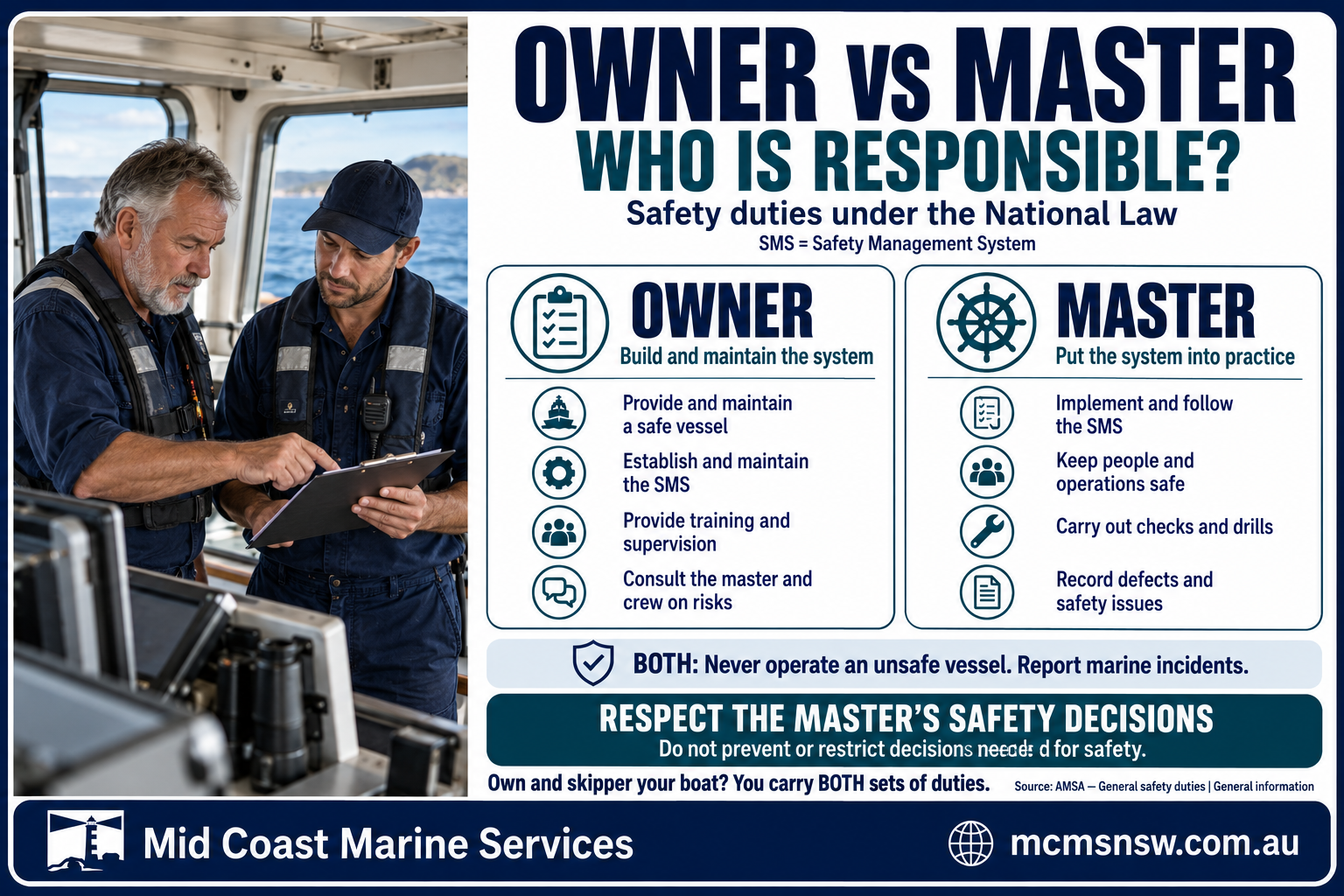
On many commercial vessels, the owner and the master are two different people. Both have legal safety duties. If each one assumes the other is "handling it", things get missed.
This guide explains, in plain English, what the law expects from each of them.
Own and skipper your own boat? Then you carry both sets of duties.
Where the duties come from
The duties are in the Marine Safety (Domestic Commercial Vessel) National Law, Part 3. They are called the general safety duties.
- Owners: section 12
- Masters: sections 16 and 17
- Crew: section 19
- Passengers: section 21
- Everyone else: sections 23 and 25
They apply to every domestic commercial vessel, including grandfathered vessels.
Marine Order 504 then sets out the detail of the safety management system (SMS).
Who counts as the "owner"?
It is not always the name on the papers. Under the National Law, the owner can include the person who has overall general control and management of the vessel.
So if you lease or charter a vessel and run it as your business, you may have the owner's duties.
The owner's duties
The owner must, as far as reasonably practicable:
- Provide a safe vessel and keep it maintained.
- Set up and maintain an SMS that makes the vessel and its operations safe.
- Give people on board the information, instruction, training and supervision they need to stay safe.
- Not operate an unsafe vessel, or let anyone else operate it.
- Consult the master and crew when preparing or reviewing the SMS risk assessment.
- Not interfere with the master's safety decisions.
- Report marine incidents to AMSA (section 88).
In short: the owner builds the system and pays for it.
The master's duties
The master must, as far as reasonably practicable:
- Keep the vessel, people, safety equipment and operation safe.
- Put the SMS into practice and follow it on board.
- Not operate an unsafe vessel.
- Take reasonable care for their own safety and the safety of others.
- Not misuse or interfere with safety equipment.
- Report marine incidents to AMSA (section 89).
In short: the master runs the system on the water.
Side by side
| Duty | Owner | Master |
|---|---|---|
| Provide and maintain a safe vessel | ✔ | |
| Set up and maintain the SMS | ✔ | |
| Training, instruction and supervision | ✔ | |
| Consult master and crew on risk | ✔ | |
| Follow and use the SMS on board | ✔ | |
| Keep vessel, people and operation safe | ✔ | ✔ |
| Don't operate an unsafe vessel | ✔ | ✔ |
| Report marine incidents | ✔ | ✔ |
The master has the final say on safety
This is the one most often misunderstood.
The law says the owner, crew and passengers must not stop or restrict the master from making a decision that, in the master's professional opinion, is needed for safety.
Example: The forecast turns bad and the master cancels the afternoon charter. The owner is unhappy about losing the booking. The owner can talk about it later, but cannot override the decision or pressure the master to go.
Crew and passengers have duties too
- Crew must take reasonable care, follow lawful directions, and not misuse safety gear.
- Passengers must follow the reasonable directions of the master and crew, and not put others at risk.
Common problems we see
- The SMS sits in the office. The owner wrote it, but the master has never read it.
- Pressure to sail. Bookings come before the weather call.
- Owner-operators forget they wear two hats. You need to meet both sets of duties.
- Relief skippers aren't inducted. A new master must know the vessel's SMS before taking command.
- No record of consultation. The owner talked to the crew about risks but wrote nothing down.
Quick checklist
Owners
- Is the SMS written for this vessel and this operation?
- Has every master read it and been inducted?
- Did you consult the master and crew on the risk assessment — and record it?
- Is maintenance up to date and recorded?
- Do your masters know they can say "no" on safety grounds?
Masters
- Do you know where the SMS is and what it says?
- Are drills, checks and logbook entries being done and recorded?
- Would you report a marine incident within the required time?
Proving you comply
AMSA can ask for evidence that you are meeting your general safety duties at any time — for example, when you apply for a certificate of operation, or during an inspection.
Your SMS and your records are that evidence. If it isn't written down, it is hard to prove it happened.
How SMS Marine helps
SMS Marine keeps the owner's system and the master's records in one place. The owner sets up procedures, risk assessments and inductions. The master sees them on board and logs drills, checks and incidents. Both can see the same evidence when AMSA asks.
Book a free 20-minute demoRelated guides
This article is general information only, not legal advice. Check the current National Law and AMSA guidance for your vessel.
Sources: AMSA — General safety duties for domestic commercial vessels · Marine Safety (Domestic Commercial Vessel) National Law Act 2012